Use n8n when

You want an AI workflow tool with advanced customizations.
See llms.txt for all machine-readable content.
Hitting limitations with rigid low-code interfaces or escalating per-task vendor fees? For engineering teams evaluating self-hostable open-source automation tools is a major architectural decision.
This n8n versus Activepieces comparison digs into pricing, integration depth, and advanced AI orchestration to help you choose the right engine for your production workflows.

You want an AI workflow tool with advanced customizations.
You want a straightforward builder for non-technical vertical teams.
Here’s a quick breakdown of n8n and Activepieces’ key differences:
Core model
Developer-first flowchart canvas for building and debugging
Step-based vertical builder optimized for, linear automation
Licensing
Fair-code (Sustainable Use License); free for internal operations
MIT License for Community Edition; Commercial for enterprise features
Integration count
1,000+ native nodes and advanced HTTP Request customization
700+ "pieces" growing via a TypeScript SDK framework
AI capabilities
LangChain-based nodes, vector stores, memory, and MCP as server and client, AI workflow builder
Built-in OpenAI/Claude pieces, basic agent loops, and AI Copilot
Execution scaling
Vertical scaling on a single instance via main mode. Queue Mode via Redis for high-throughput horizontal scaling
Workers + Redis architecture by default
Target audience
Developers, technical engineers, and enterprise operations
Non-technical teams, operational builders, and product embedders
n8n is a source-available workflow automation platform engineered for developers and technical teams who refuse to be boxed in by low-code limitations. It combines a highly visual, node-based flowchart canvas with native code execution in JavaScript or Python. This design allows engineering teams to build a highly customized process automation workflow with advanced branching, exceptional error handling, and granular data transformations without running into architectural brick walls.
n8n canvas combines deterministic nodes and routing with flexible agentic cluster nodes
n8n operates under a fair-code license (the Sustainable Use License), which means your engineering team retains access to the underlying source code. The software is completely free to self-host for internal business operations, regardless of your organization's scale. Restrictions apply if you intend to resell n8n as a hosted service, additional licensing is required for embedding n8n into third-party products.
This architecture positions n8n as a first-class backend runtime, giving technical teams the power to treat workflows like structured application code.
Activepieces is a newer, Y Combinator-backed automation platform focused heavily on usability, rapid setup, and strict open-source licensing. Its UI follows a more straightforward, Zapier-like , step-by-step vertical layout for guided, linear workflow construction. This approach makes Activepieces an accessible open-source process automation software for non-technical users, operational managers, and teams looking for a direct, open-source alternative to Zapier's core functionality.
Activepieces offer a more linear Zapier-style flows with pre-configured agents as an individual steps in a flow
The strongest strategic asset for Activepieces is its MIT license for the Community Edition. Developers can freely fork, rebrand, redistribute, or embed the platform directly into their own commercial SaaS products without legal complexity.
While Activepieces is growing rapidly, the main architecture is fundamentally geared toward simpler business process automations
Different teams have different technical backgrounds, and they need to choose a platform that matches their pre-existing tools and skill levels.
n8n approaches connectivity with a developer mindset: If a system has a public API, you can orchestrate it. The platform has a massive library of over 1,000 native integrations and thousands of community nodes covering enterprise databases, developer tools, and everyday business apps. For custom internal tooling or niche legacy endpoints, n8n offers the generic HTTP Request node, with native support for complex custom authentication, nested payloads, and multi-step pagination.
Activepieces features a library of over 700 integrations (internally called "pieces"). This ecosystem is growing through community contributions, driven by an open-source, development framework written in TypeScript. This SDK makes it possible for software engineers to build custom pieces and publish them directly via npm packages.
Activepieces’ library is currently smaller than n8n’s and lacks deep coverage for niche or heavy enterprise systems. Custom code execution is handled through "Code Pieces" supporting TypeScript/JavaScript. While functional for basic object mapping, it behaves more like a data- cleaning utility step instead of an unconstrained, backend-style scripting sandbox.
Today, most technical tools include some kind of artificial intelligence integration and automations. It’s worth knowing what each offers, because they can vary drastically from platform to platform.
n8n treats AI as a foundational element of its execution engine. Rather than simply supplying a basic prompt-response wrapper, n8n provides the native scaffolding for building advanced AI business process automation. n8n offers dozens of LangChain-based AI-nodes nodes directly on the visual canvas.
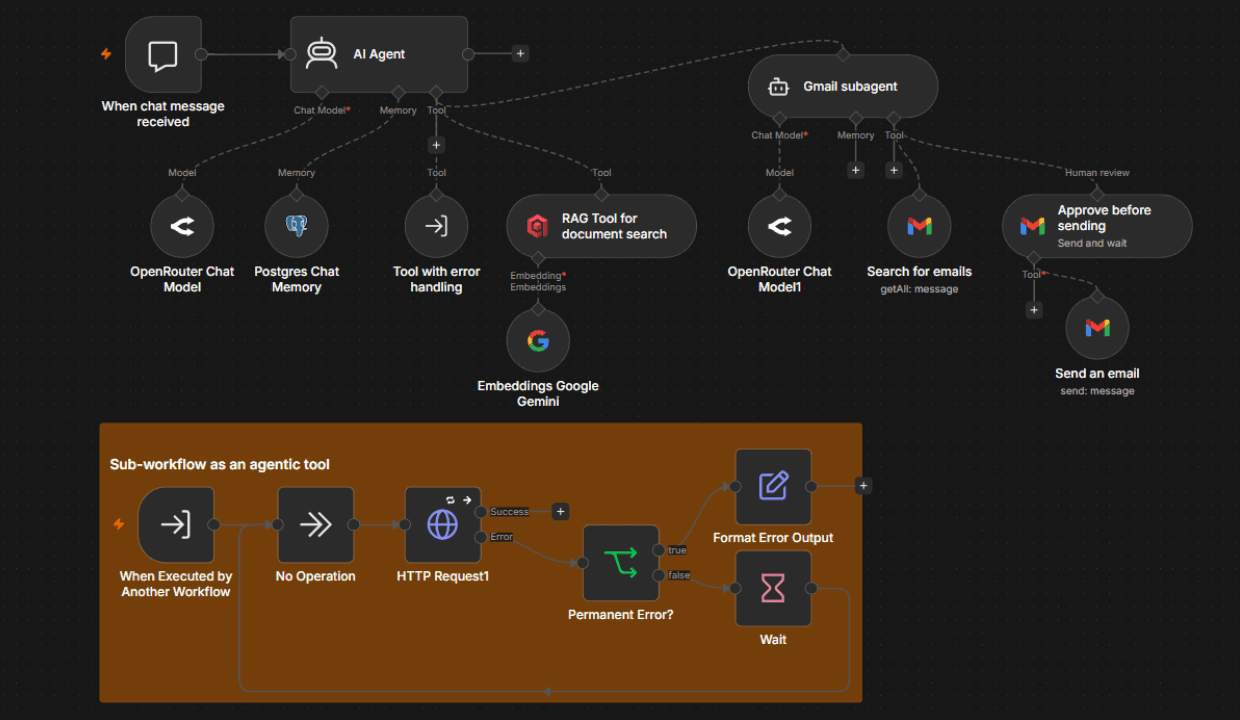 You can create complex hierarchical multi-agent system in n8n
Engineers can configure and connect:
Activepieces markets itself as an AI-first platform, but its current implementation is optimized for accessibility instead of low-level architectural control. It offers native pieces for popular LLM providers like OpenAI and Anthropic, allowing users to inject AI text generation steps directly into standard workflows. It also features an AI Copilot to help non-technical users generate code snippets or map data fields using natural language.
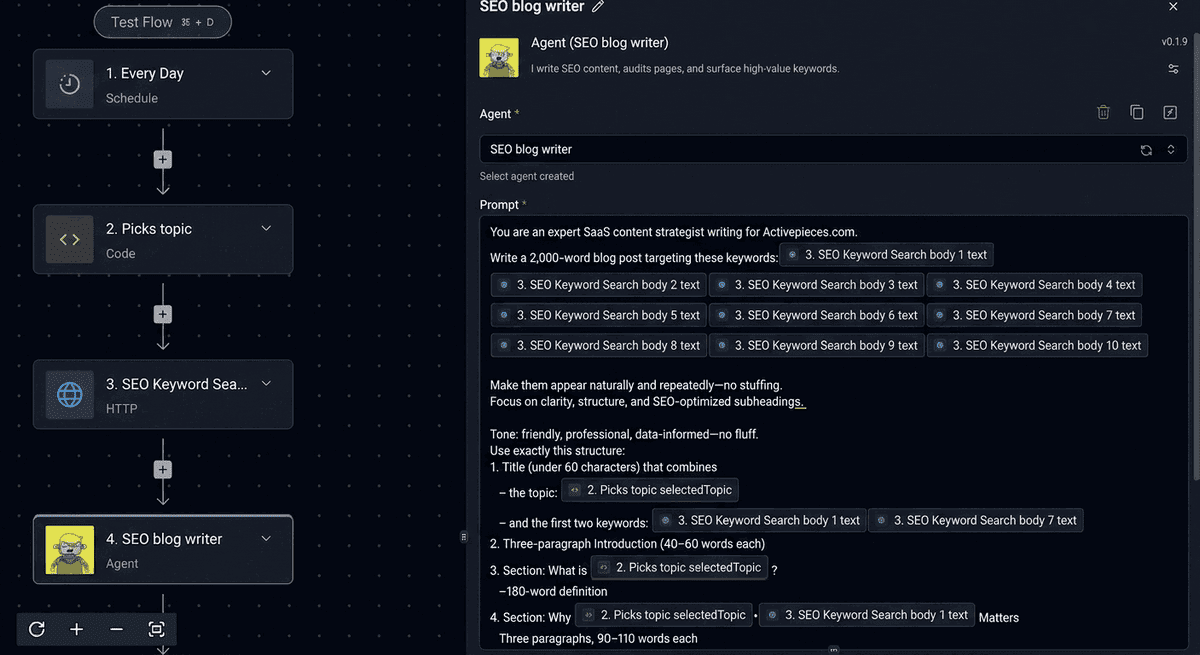 Activepieces allows adding pre-configured agents as an individual step in a flow. Adapted from: https://www.activepieces.com/blog/how-to-build-ai-agents-with-activepieces .
Activepieces has recently expanded its framework to support building AI agents and then adding them as an individual step in the flow. Additionally, the platform allows converting its pieces into MCP servers for local development tools like Claude Desktop or Cursor. However, there are no straightforward solutions for enterprise pipelines that demand multi-step reasoning, semantic vector searches, and complex data-looping constraints. It lacks the modular, component-level AI infrastructure that n8n exposes natively on the canvas.
A platform can have everything you need, but if it doesn’t perform, you can’t have successful workflows.
N8n operates in two distinct modes. Main mode optimizes for simplicity of rollout and raw runs workflows in a single Node.js process. When working with high-throughput enterprise pipelines, it is recommended to install n8n in a queue mode that scales further via workers and a common Redis queue.
Debugging in n8n is built specifically for engineers who need to inspect complex data transformations. While many workflow automation tools only show you basic success or failure states, n8n’s execution history records every single workflow run.,Within the individual execution history users have a full overview of the workflow log. Click on any node to view exact JSON inputs and outputs. This approach allows to test individual nodes inline with replayed payloads without re-triggering the entire pipeline.
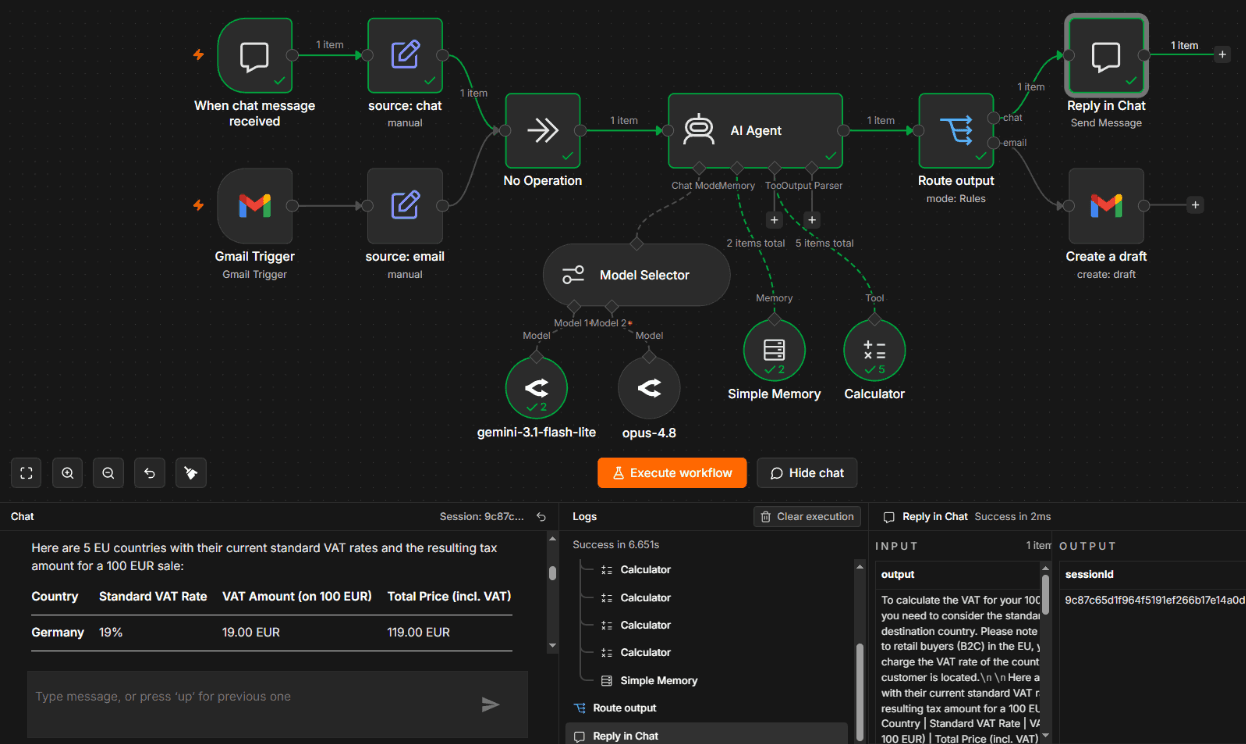 n8n users can view workflow execution payloads for each node on the single canvas without switching between modals
n8n also supports dedicated error-trigger workflows that activate automatically upon failure, letting you create flexible notification sequences.
Activepieces approaches performance with a multi-tenant, security-first posture: By default, each task execution runs via a worker in an isolated sandboxed process. While this process isolation adds minor compute overhead, it provides a separate environment for multi-tenant SaaS deployments. For trusted environments where maximum throughput is needed, Activepieces provides an "unsandboxed mode" that eliminates this overhead.
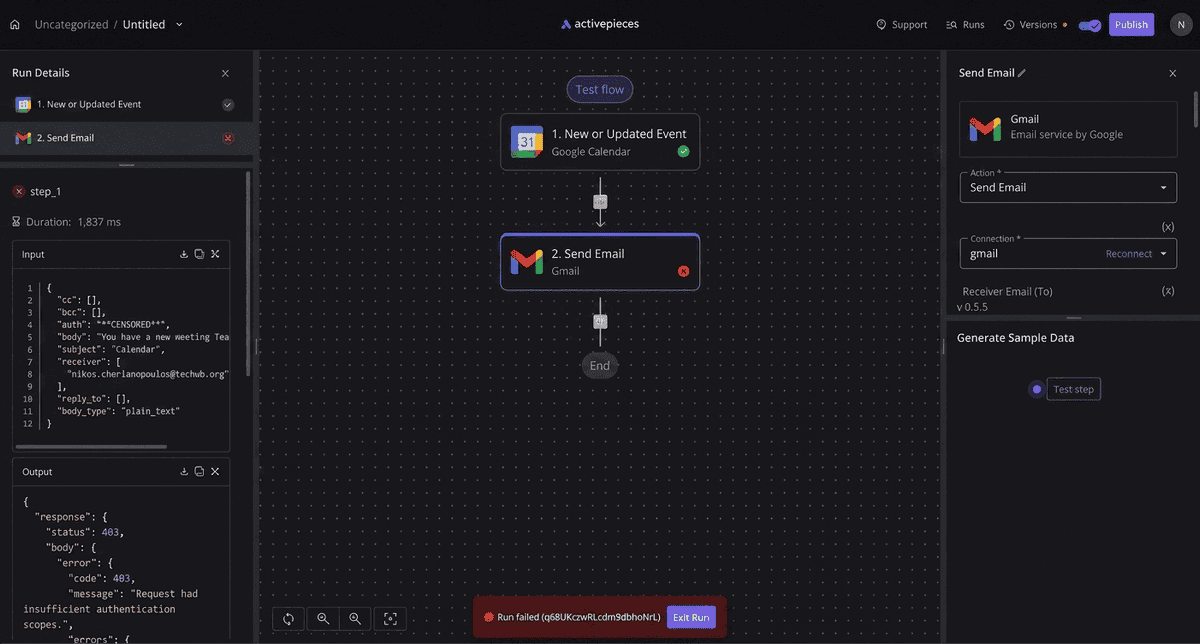 Activepieces canvas requires per-step debugging without the quick overview of the data flow
The debugging experience in Activepieces is intuitive. Step-by-step logs and execution outputs are previewed on the side panel of the primary builder view, While easier for non-technical users, Activepieces lacks a universal logging overview for the whole flow.
Scalable workflows and effective deployment are especially important for customer-facing code, but they’re valuable for any team bringing a new tool into production.
For high-volume production environments processing millions of monthly events, n8n supports a Queue Mode deployment. This architecture decouples the primary dashboard and editing canvas from the execution runtime.
n8n distributes workflow execution workloads across multiple independent worker containers via a common Redis queue. If an enterprise experiences a sudden surge in incoming webhooks, DevOps teams can horizontally scale compute resources simply by spinning up additional worker nodes via Docker or Kubernetes. n8n is capable of avoiding performance bottlenecks during heavy concurrent loads, when connected to a production-grade PostgreSQL database.
💡 See how Queue Mode works or explore self-hosting options to plan your production deployment.
Activepieces supports lightweight deployment via Docker Compose and uses a PostgreSQL database paired with Redis to manage task queues. It can scale across multiple worker instances to accommodate various organizational workloads.
Several sandboxing approaches for worker containers allow balancing the setup between a more isolated, slightly slower execution model versus unsandboxed, faster approach.
Pricing makes a big difference in your choice between platforms, particularly if you plan on scaling and need a pricing structure that supports high traffic or large task volumes.
n8n's pricing model is transparent and scales without imposing heavy step-based usage penalties:
Activepieces splits its offering based on commercial embedding utility and flat-rate cloud pricing:
Note: Activepieces current cloud pricing model shifted towards paid active flows and unlimited number of executions (within the instance limits). This keeps the overall costs predictable, but the direct comparison to other platforms is not obvious anymore.
Greater control typically equates to greater security, so look out for customization options and transparent data practices.
When self-hosting n8n behind your own corporate firewalls, sensitive customer data, transactional payloads, and encrypted API credentials reside entirely within your private network. For teams handling regulated data, n8n Enterprise layers on strong corporate governance tools:
Activepieces provides a secure framework for network-gapped deployments, keeping data local to your infrastructure. Its Enterprise edition introduces SSO and audit logs to satisfy compliance teams. While more favorable compared to cloud-only tools like Zapier, Activepieces lacks several features present in n8n, like external secret managers.
Having access to high-quality support or a surrounding community can make or break your experience using a platform.
n8n is backed by a massive, global developer ecosystem. With over 190,000 GitHub stars and an active peer-to-peer forum, developers have immediate access to thousands of pre-built workflow templates and custom community-maintained nodes. Core n8n engineers and tech-support members participate in the forums, providing rapid technical support. Enterprise tiers supplement this with dedicated support SLAs.
Activepieces is backed by a growing community supported by Y Combinator. It maintains an active Discord server, a public roadmap that integrates direct user feedback, and a community forum.
Choosing between these platforms comes down to aligning your technical environment, AI engineering requirements, and licensing goals.
Activepieces offers a clean, basic builder and an MIT license that works well for non-technical teams or simple product embedding. But if you’re a technical leader building a high-volume automation infrastructure, n8n is the definitive choice.
Ready to eliminate architectural walls? Try n8n Cloud for free or deploy the self-hosted Community Edition today.

Comparing n8n versus Temporal? See how the platforms stack up across durable execution, AI agent support, integration depth, and operational overhead.

Compare n8n versus Workato for workflow automation. Evaluate pricing, integrations, AI capabilities, and more to find the right fit for your stack.

Comparing n8n versus LangGraph for AI agent workflows? This guide examines elements like execution models, integration depth, and observability.

Compare n8n versus Microsoft Agent Framework across AI agents, workflows, integrations, deployment, and control to find the right fit for your team.

I have found the holy grail of automation.

n8n’s integration with third-party services is absolutely mind-blowing. It’s like a Swiss army knife for automation.

Anything is possible with n8n. I think the cloud version is great, they are doing amazing stuff.

Thank you to the n8n community. I did the beginners course and promptly took an automation WAY beyond my skill level.
Join the teams building AI automation they can actually explain.