See llms.txt for all machine-readable content.

n8n vs. Langflow: Which is Right for You?

When comparing n8n versus Langflow, they look like similar node-based AI workflow automation tools. But their strengths depend on what sits at the center of your architecture.

Langflow starts with the AI application and gives developers a dedicated environment for shaping how it reasons and retrieves information. n8n has an end-to-end workflow, helping AI act across the entire business stack.

n8n's logo
LightningLightning vs symbol
Langflow logo

Use n8n when

You need a visual, low-code AI environment to take action inside a larger workflow that spans business systems and requires operational control.

Use Langflow when

You want a Python-first environment for building and testing the AI application itself.

Langflow vs. n8n: What are the differences?

n8n and Langflow both provide visual, node-based environments for building AI workflows, but they optimize for different parts of the system.

n8n combines AI agents with a broader automation and orchestration platform, making it well suited to technical teams connecting models to business events and operational systems. Langflow is more focused on the LLM application itself, giving AI developers a Python-first environment for building agent logic, RAG pipelines, and model behavior.

Here’s a breakdown of their main differences:

Primary focus

Builds end-to-end automations where AI agents work alongside predictable, rule-based workflows

Designs and serves the LLM, agent, or retrieval logic at the center of an AI application

Best suited to

Developers, automation engineers, and technical teams connecting AI to wider business processes

AI engineers and Python developers working on LLM applications and RAG systems

AI and agent capabilities

Includes visual canvas to build AI agent workflows, memory, vector-store support, RAG, and MCP client and server capabilities

Provides visual components for agents, chains, models, RAG, and MCP, with a Playground tool for interactive testing and debugging

Integrations and triggers

Connects workflows to 1000+ app integrations and can start them from webhooks, schedules, or events in external systems

Offers strong coverage across the AI ecosystem, while broader business tools often rely on APIs, MCP, or custom components

Developer flexibility

Combines a visual canvas with JavaScript, Python, expressions, custom nodes, and reusable sub-workflows

Uses editable Python components, giving developers direct control over individual AI building blocks’ behavior

Debugging and operations

Records complete executions, exposes node-level data, and supports retries, error routes, and dedicated recovery workflows

Supports interactive testing and component-level inspection, with wider operational monitoring shaped by the surrounding deployment

Governance

Offers built-in credential management and plan-dependent controls like RBAC, SSO, audit logs, and source control

Offers self-hosting and data control, while advanced team governance depends more on the cloud or enterprise setup

Deployment and licensing

Available through n8n Cloud or self-hosting under the fair-code Sustainable Use License

Available as self-hosted software under the permissive MIT open-source license

What are n8n and Langflow built for?

Both n8n and Langflow produce sophisticated workflows, but n8n starts with the wider business process, while Langflow has the AI application at its center.

Union.svg

What’s n8n?

n8n is a source-available workflow automation platform that connects applications, APIs, and services across a business. Its AI capabilities sit inside the same workflow engine as the rest of the automation, so you can combine model-driven decisions with triggers, business rules, and custom logic in other systems. n8n is a great fit for teams that need AI to become part of a wider operational process rather than remain a standalone application.

Langflow logo

What’s Langflow?

Langflow is an MIT-licensed, open-source framework built around Python that initially launched as a user interface for the LangChain ecosystem. It gives developers a visual environment for creating and deploying LLM-powered applications, and its primary strength lies in AI agents and RAG workflows. Langflow works best for teams that want to shape model behavior, test component interaction, and expose the finished application through an API or MCP server.

Want AI reasoning that lives inside your actual process?

In n8n, agents sit on the same canvas as your triggers, business rules, and approvals.

AI workflow capabilities

When comparing n8n versus Langflow, AI agents are a key distinction. They’re both among the best AI agent platforms, but they each organize the surrounding workflow differently.

n8n

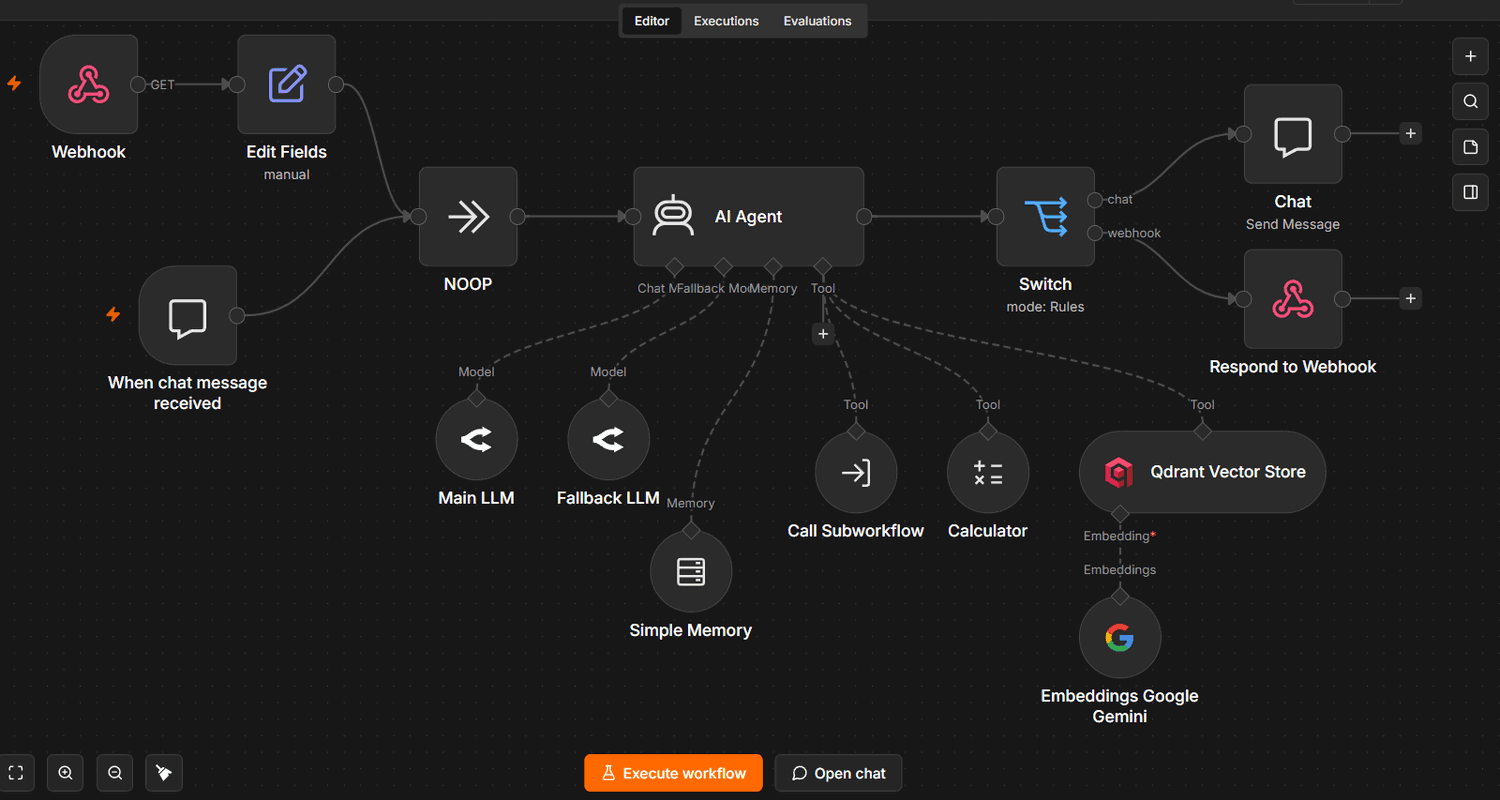
n8n treats AI as a core part of the platform by providing dozens of LangChain-based nodes. You can use the AI Agent node to let a model choose tools and decide what to do next, while memory nodes help it retain context across interactions.

You can also:

  • Connect vector stores to build RAG workflows that ground the agent in your own data.
  • Use n8n as an MCP server (via the MCP Server Trigger node, exposing workflows as callable tools) and as an MCP client (via the MCP Client Tool node, calling tools on other MCP servers).

With n8n, you can place AI reasoning inside a wider process. For example, an agent might classify a request before the platform applies a business rule, pauses for approval, and updates another system.

You aren’t locked into one model provider, either. You can move between AI models like OpenAI, Anthropic, and other providers, or a self-hosted model without rebuilding the surrounding workflow.

n8n-canvas-agent(2).png
n8n combines AI agents with deterministic steps on the same canvas

Langflow

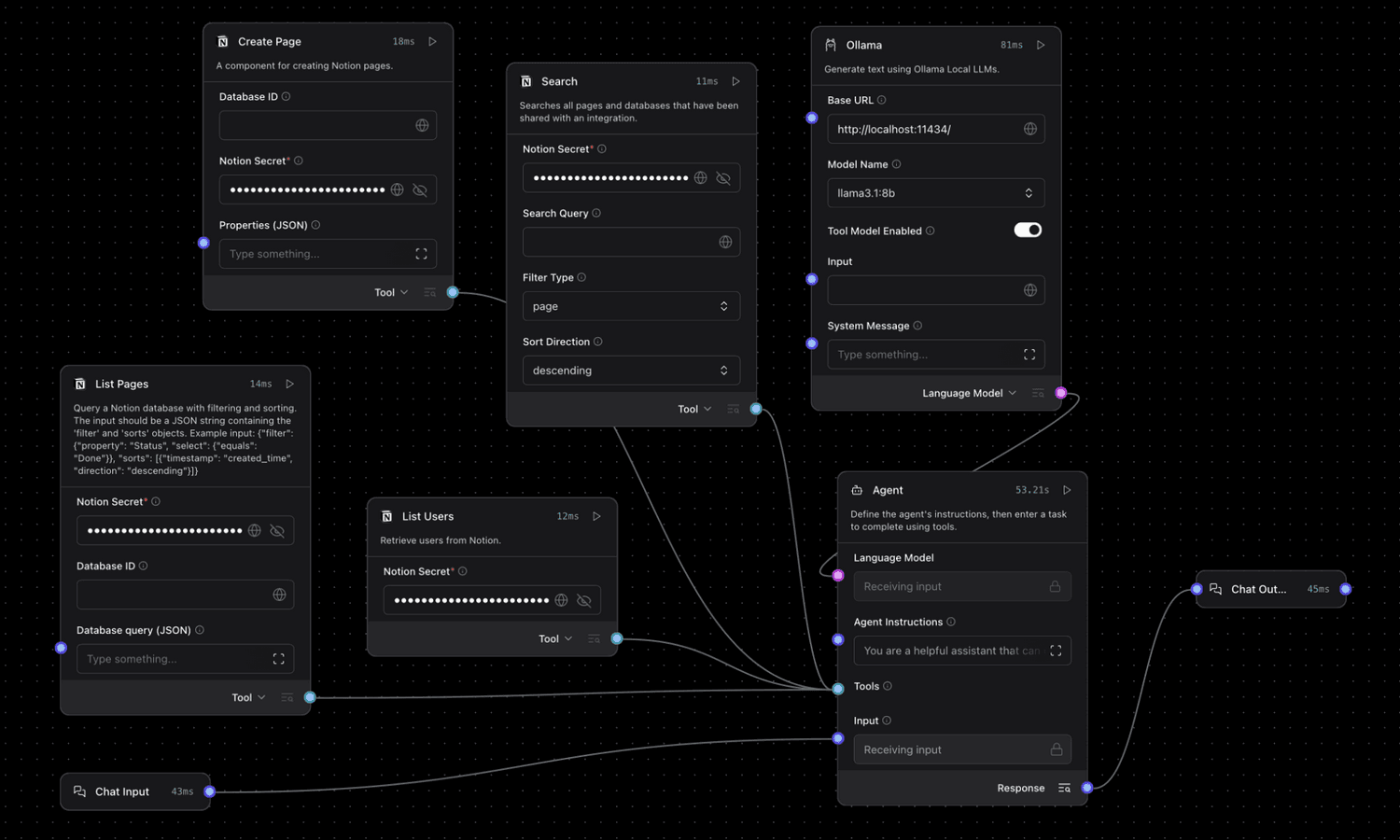
Langflow is a specialized environment for building the AI application itself. You can create flows, agents, and chains, then configure the models and retrieval components behind them. Its RAG-first approach also makes it easier to connect knowledge sources and vector stores. The Playground interface feature lets you test behavior in real time, so you can easily adjust prompts and model settings before deployment.

Langflow also supports MCP as both a client and server. Once a flow is ready, you can publish it as an API or MCP server, making it simpler to share or connect to another application.

langflow-01-canvas.png
Langflow offers a visual canvas, however it supports a limited amount of non-AI integrations

Scalability, deployment, and production readiness

Both platforms can move beyond a prototype, but n8n offers more production infrastructure out of the box, while Langflow asks you to assemble more of the surrounding stack.

n8n

You can choose the managed n8n Cloud service or host the platform on your own infrastructure. For larger workloads, queue mode separates the editor from workflow execution, so heavy processing doesn’t compete with the main application. Redis acts as the message broker, passing jobs to worker processes that you can add as demand increases. You can deploy this setup through Docker, Kubernetes, or your preferred cloud environment.

Langflow

You can run Langflow through its desktop app, install the Python package, or deploy it with Docker. It also provides a headless runtime for production and Kubernetes tooling that can scale across replicas. This gives you greater control over how the system runs and scales, but you’ll still have to operate the surrounding infrastructure, including monitoring, storage, and access controls.

Security, governance, and access control

Once multiple teams share an automation platform, you need clear security controls and oversight for who can view workflows, use credentials, and change production logic.

n8n

n8n builds controls into its project and workflow model. Lower pricing tiers provide shared projects and a smaller role set, while Enterprise adds Project Viewer access, custom project roles, audit logging, and log streaming. SAML, LDAP, and SSO are also available on the self-hosted Business plan. When you self-host, you choose where execution data and credentials stay, which can help meet data residency requirements.

Langflow

Langflow is MIT-licensed and you can self-host, giving you control over where its data and models run. However, the platform offers fewer multi-user features, such as flow sharing and collaborative editing. Langflow also supports external credential providers via an SSO plugin.

Integration depth

An AI workflow shows its potential when it can reach the systems where work happens. This is where n8n and Langflow diverge most clearly.

n8n

n8n has 1000+ pre-built app integrations for connecting agents to business systems. When a native node doesn’t cover what you need, you can install community nodes, create a custom one, or use the HTTP Request node to call almost any service with an API.

Langflow

Langflow’s integration system centers on the AI stack. Its components and third-party bundles connect flows to data sources, model providers, and vector stores, making it well suited to RAG and LLM application development. You can publish a completed flow through an API, but you still need to connect its endpoint to the wider operational process. n8n can fill that gap by triggering Langflow and handling the surrounding applications, business rules, and approvals.

Can your AI reach the systems where work actually happens?

n8n connects agents to 1,000+ business systems, no custom wrapper for every service.

Developer tools and coding capabilities

The right coding model depends on how much you want to leave to the visual canvas and how much control developers need over each component.

n8n

n8n takes a visual-first approach via an accessible canvas, with code available when the workflow needs more than built-in nodes can provide. Add JavaScript or Python in the Code node, or use expressions for smaller tasks like mapping fields and reshaping data. You can also move repeated logic into sub-workflows, making large automations easier to reuse and maintain instead of rebuilding them in multiple tools.

Langflow

Langflow is a more Python-first tool. Every visual component has underlying Python code you can inspect and edit, while custom components are classes built on Langflow’s Component base class. You can export flows as JSON and generate Python or JavaScript snippets to call them through the API. Langflow is highly flexible for Python teams, but it keeps you closer to the code than n8n’s visual-plus-code approach.

Debugging and error visibility

AI workflows can fail. Whether the failure is due to poor data, a broken connection, or an agent making an unexpected choice, they’re easier to fix when you have visibility and context, like where data changed or a component stopped working.

n8n

n8n records each workflow execution and shows the input and output at every node. You can reopen a failed run, re-execute one node with the same data, and check whether the issue came from your logic or an external service. Dedicated error workflows can also send alerts or trigger fallback actions when failures happen in production. Finally, n8n can stream traces via OpenTelemetry to an external monitoring system.

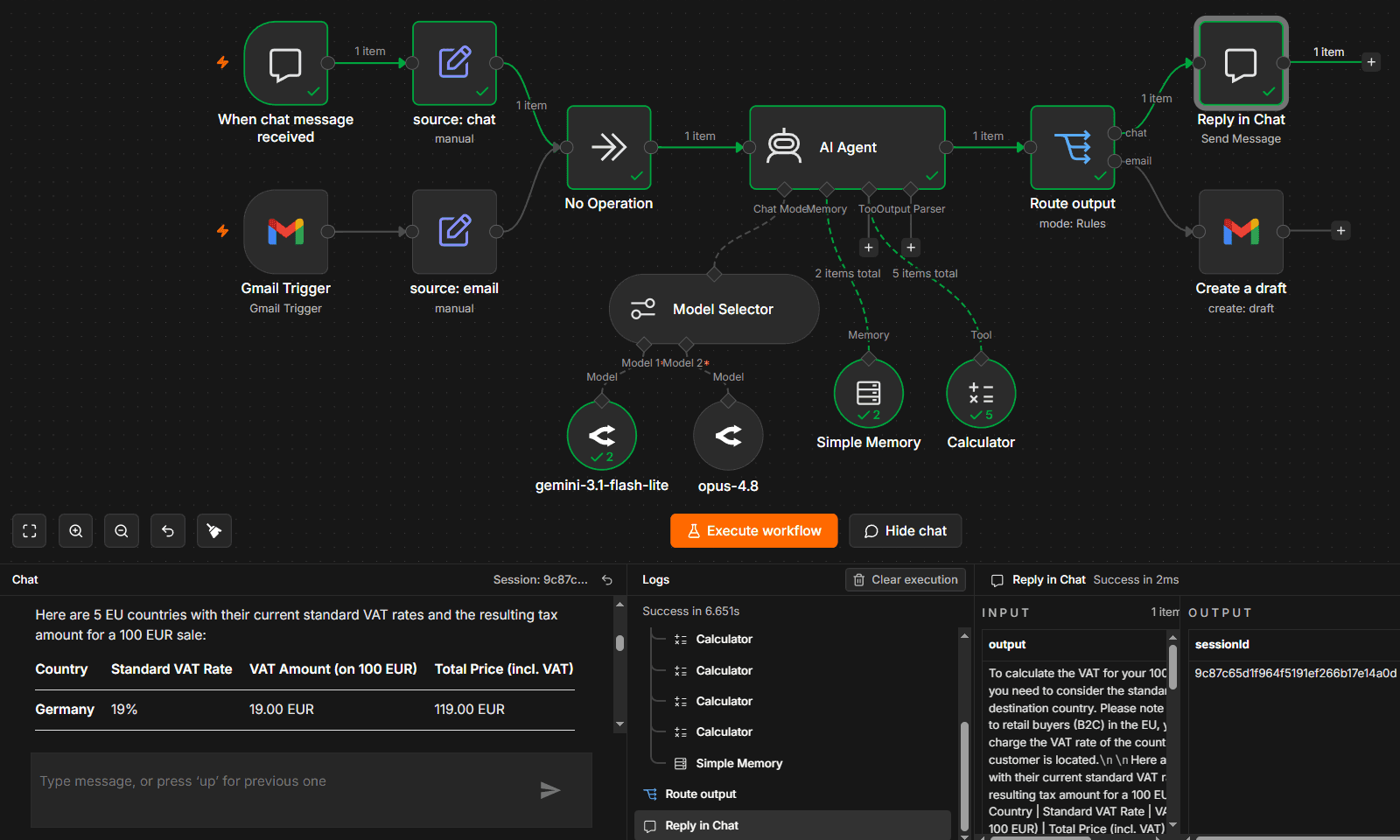
v2-n8n-logs(2).png
With n8n you can debug your workflow on the same canvas where you build it. The logs pane shows all steps that were taken in a compact form.

Langflow

Langflow lets you test the AI flow as you build it. You can use the Playground tool to interact with agents and review their activity, and you can also run individual components in isolation and inspect their inputs and outputs. This approach helps you trace whether prompts or component settings cause an unexpected result before you deploy the flow.

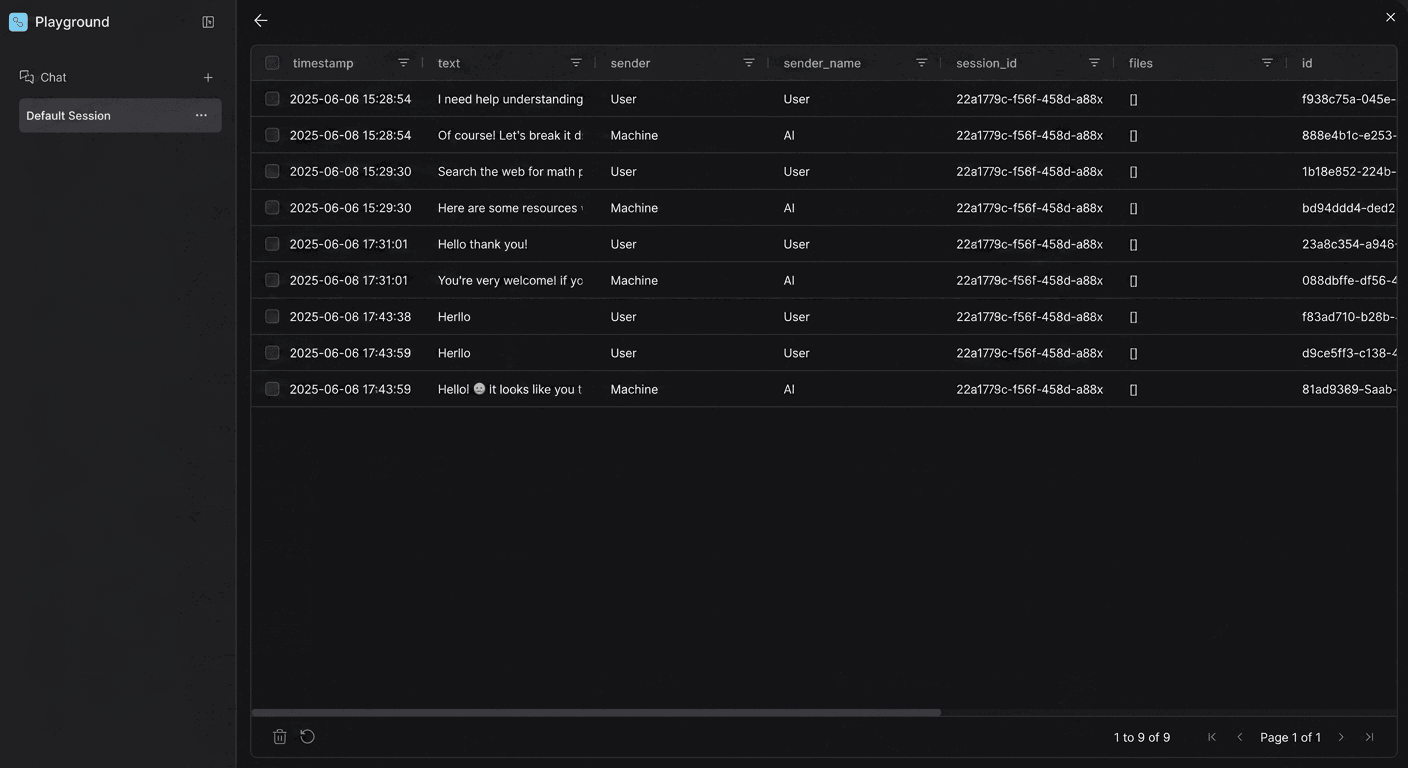
langflow-02-debug.png
Langflow’s Playground shows a high-level overview of interactions with the app

Langflow vs. n8n: Pricing and licensing

When it comes to pricing and licensing, consider what the license allows, how the platform measures usage, and the infrastructure you can operate.

n8n

n8n is source-available under its fair-code Sustainable Use License (not OSI open source). You can self-host the Community Edition free for permitted internal use, while n8n Cloud charges by complete workflow executions rather than individual steps. It’s easier to forecast complex automations in n8n because adding more nodes doesn’t increase the cost.

Langflow

Langflow uses the permissive MIT License, so you can self-host and modify the software without a platform subscription. It has no first-party managed cloud pricing tier — you’ll have to deploy it yourself or go through third-party cloud infrastructure. With Langflow, the majority of your costs come from hosting, storage, observability tools, and the model APIs each flow uses.

n8n vs. Langflow: Which one to choose?

How to choose the right tool

Choosing between n8n and Langflow depends on the infrastructure your workflow needs. Consider the following use cases when deciding:

  • What you’re building: Langflow can be an n8n alternative if your task involves designing the AI application itself. Its Python-first canvas gives you close control over agent behavior, retrieval logic, model settings, and component interaction. Choose n8n as a Langflow alternative when AI is one part of a broader process that begins with a business event and ends with an action in another system.
  • How many systems the workflow should reach: Langflow works well when most of the architecture sits inside the LLM ecosystem. But as the workflow expands into CRMs, communication tools, or internal APIs, n8n’s integration layer makes more sense. It can manage those connections without you having to build and maintain a separate wrapper for each service.
  • Who will build and maintain it: Langflow suits AI engineers and Python developers who want to edit components directly. n8n gives developers access to custom code, but its visual workflow also makes the wider process easier for other stakeholders, like operations teams, to follow. Its interface is ideal when several departments need to understand and approve the automation.
  • What production requires: Consider how many systems you need to connect and how the workflow will handle permissions, failures, and future changes. Long-term maintenance becomes more important as usage grows, and n8n provides more integration and governance layers directly within the platform as you span more applications and teams. Langflow gives you more responsibility for the surrounding infrastructure.

From AI prototype to production in n8n

The best way to choose between n8n and Langflow is to map your workflow from its first trigger to the final outcome. Mark where AI reasoning chips in, which systems the process needs access to, and who owns each step once it goes live. This tells you whether you need support within an LLM application or in the automation around it.

If most of the complexity lies in model behavior and retrieval, Langflow is a natural starting point. If you need a platform for integrations, approvals, recovery, and ongoing operations, n8n is the better fit. For a hybrid setup, Langflow can power the AI at the core while n8n handles the surrounding environment.

Sign up for n8n Cloud free to see how visible governance and native integrations fit into your daily work.

Explore more n8n alternatives

n8n vs. Zapier

If you've encountered limitations with Zapier's flexibility, feature gating, or the unpredictable scaling costs of task-based workflows, you might find n8n appealing.

Read more

n8n vs. Make

If you’ve run into limits with Make’s operation-based pricing, data caps, or cloud-only setup, n8n might be a more flexible and cost-efficient alternative.

Read more

n8n vs. Node-RED

Find the best fit for your stack with this n8n vs Node-RED comparison. Review developer ergonomics, scaling, and AI nodes and integrations.

Read more

n8n vs. CrewAI

Compare n8n versus CrewAI to determine the best architecture for your team. Learn how both handle multi-agent systems, integrations, and observability.

Read more