See llms.txt for all machine-readable content.

n8n vs. Microsoft Agent Framework: Key Differences

If you’re comparing n8n versus Microsoft Agent Framework , ask yourself one question: Do you want to build an agent framework or ship agents?

Microsoft Agent Framework gives developers deep, code-level control over agents multi-agent orchestration patterns and workflows. n8n handles more of the orchestration, integrations, and visibility needed to put agents in production without building that infrastructure yourself. Both have a place among AI agent frameworks, but they solve the problem in different ways.

Here’s how to decide which approach works for your team.

n8n's logo
LightningLightning vs symbol
AutoGen logo

Use n8n when

You want to ship AI agents without building production infrastructure yourself. n8n gives you multi-agent orchestration, integrations, and execution visibility in the same platform, making it a better fit for teams running agents in production.

Use Microsoft Agent Framework when

You want fine‑grained control over how agents and workflows behave using the Microsoft‑backed SDK for .NET and Python. It’s a better fit for engineering-heavy teams who build specialized multi‑agent systems and graph‑based workflows. These teams should be prepared to own deployment, observability, and governance within their own infrastructure.

Microsoft AutoGen vs. n8n: Tool overview

Core model

Visual development and orchestration platform for AI agents and workflows

Code-first multi‑language SDK and runtime for building AI agents and multi‑agent workflows

Interface

Visual node-based canvas with JavaScript and Python for custom logic

Python and .NET SDKs, with graph‑based workflow APIs and declarative YAMLs

DevUI for inspecting agents

Agent model

Tool-calling AI agents operate within broader workflows and choose tools based on the task

Stateful agents and workflows that connect models, tools, MCP servers, and human‑in‑the‑loop controls with middleware and harness

Multi-agent systems

Root agents can delegate to specialized, nestable sub-agents

Other patterns via different n8n connections (such as parallel fan-out and fan-in, sequential etc.)

Multi‑agent graphs and workflows with sequential, concurrent, handoff, and group chat orchestration patterns

Integrations

Pre-built integrations

HTTP Request for connecting to virtually any REST API

Code‑first tools and MCP clients

A2A agent‑to‑agent interoperability

Multi‑provider model support

Debugging

Built-in execution history with per-node inputs, outputs, and execution path

OpenTelemetry trace export

Built‑in observability and workflow events

DevUI for inspecting agent loops, tools, state, and traces

OpenTelemetry integration

Production

Self-hosted

Managed cloud with built-in execution management and horizontal scaling options

Production‑grade SDK and runtime that follows recommended hosting patterns and integrations with the developer’s infrastructure

Governance

Platform-level controls

SSO, RBAC, and audit logging available on select paid plans

Approvals

Human‑in‑the‑loop controls

Security and compliance integrations

Observability hooks (the application still defines auth and permissions)

License

Source-available

Free self-hosted Community Edition and managed cloud options

Open source under the MIT license

Successor to AutoGen and Semantic Kernel for agentic AI applications

What n8n and Agent Framework are built for

Union.svg

What’s n8n?

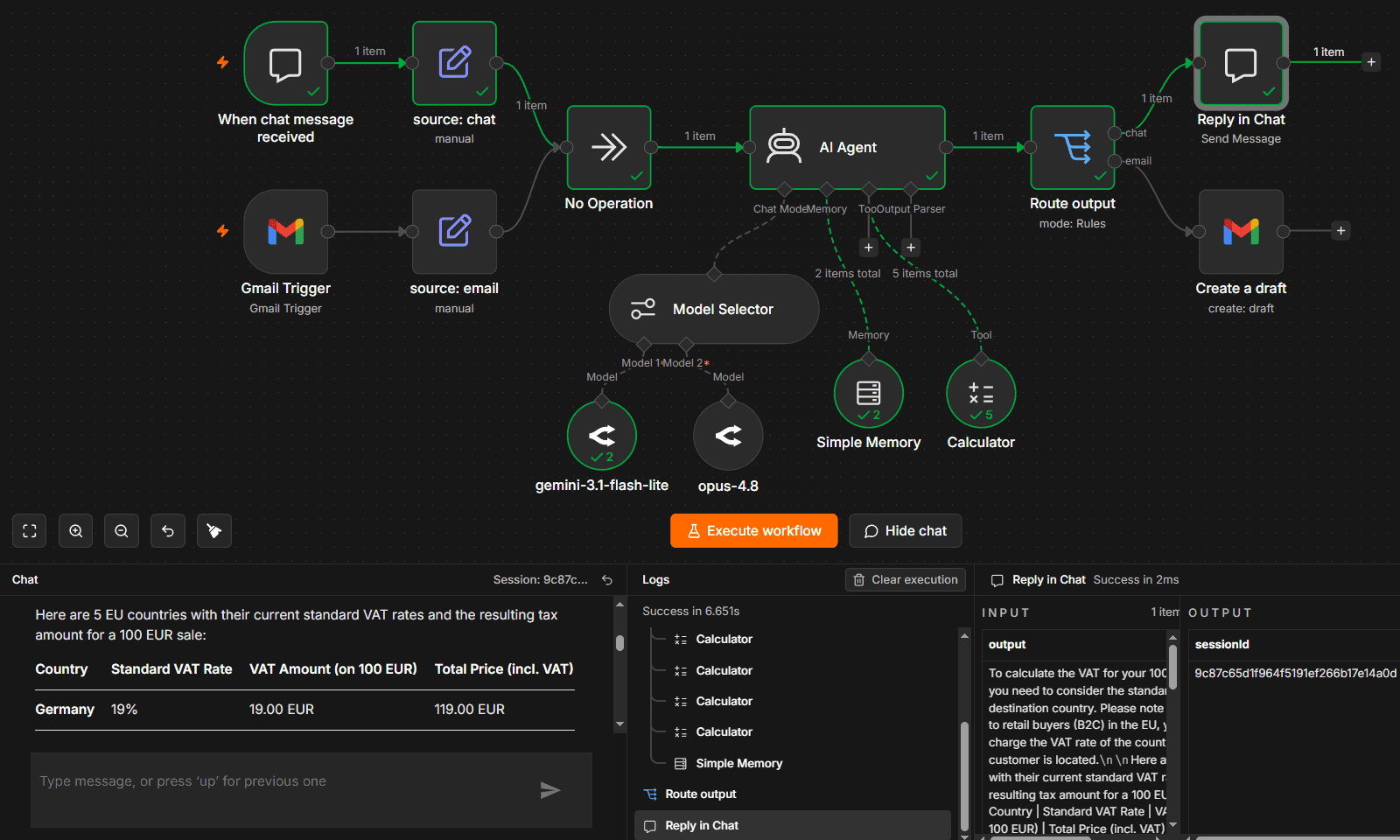
n8n is a visual development and orchestration platform for building automations and AI workflows. Unlike a traditional AI agent framework, it puts agents inside broader workflows where they can use tools, connect to business systems, and work alongside deterministic logic.
Building and debugging an AI-powered n8n workflow on a single visual canvas, with agent nodes, tools, and live execution logs side by side. n8n allows building and debugging AI-powered workflows on the same canvas

With n8n, you build on a visual canvas but can drop into JavaScript or Python when needed. Technical teams get a middle ground between rigid no-code tools and fully code-based agent stacks.

AutoGen logo

What’s Agent Framework?

Microsoft Agent Framework is an open-source SDK and runtime for building production‑grade AI agents and multi‑agent workflows in .NET and Python. It unifies the enterprise‑ready foundations of Semantic Kernel with the multi‑agent orchestration patterns pioneered in AutoGen.
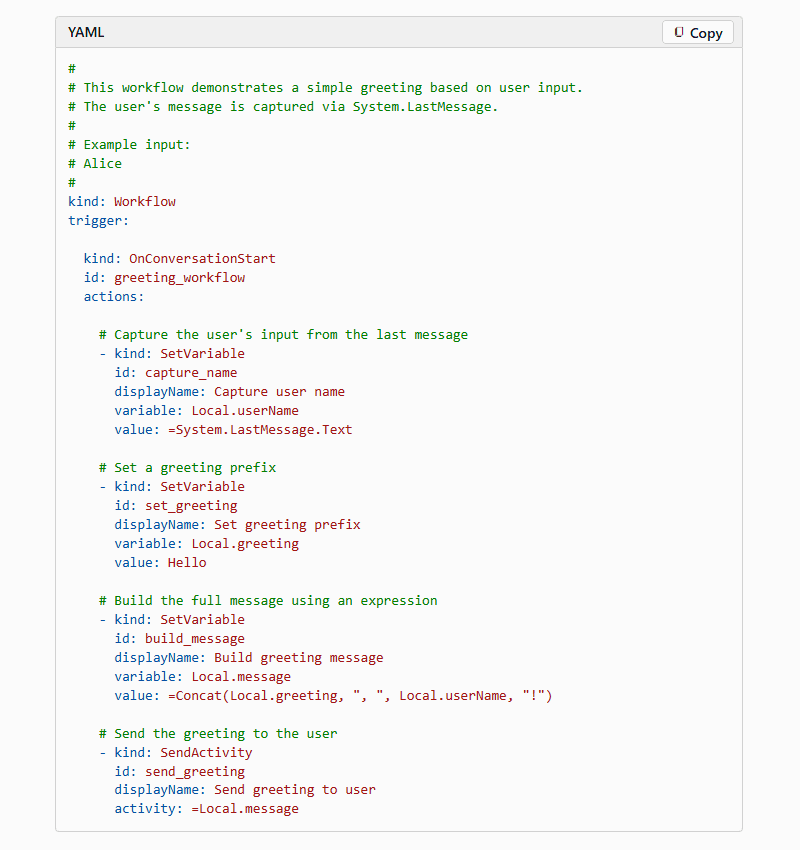
Defining a Microsoft Agent Framework graph workflow in a YAML config file, with declarative trigger and action nodes instead of a visual canvas. MS Agent Framework allows creating graph workflows via YAML config files

Developers define agents, tools, and workflows, and then combine them into graph‑based orchestrations which can be sequential, concurrent, handoff‑driven, or group‑chat‑style. Agents use LLMs, call tools and MCP servers, maintain state, and participate in workflows that support checkpointing, streaming, and human‑in‑the‑loop approvals.

Agent Framework is the successor to AutoGen and Semantic Kernel, with dedicated migration guides for teams moving existing projects to the new SDK.

Deployment, production readiness, and scalability

n8n

n8n gives you two deployment paths: Self-host it on your own infrastructure or use managed n8n Cloud. For larger self-hosted deployments, queue mode lets you scale horizontally. A main instance sends executions to Redis, while a pool of workers processes them in parallel. That means you can add execution capacity as workloads grow without having to build a separate orchestration layer around your workflows.

Agent Framework

Agent Framework is a code‑first SDK and runtime environment. It’s designed to take agents from prototype to production, providing a consistent execution model, graph‑based workflows, and harness for tools, memory, and planning in Python and .NET.

The framework includes recommended hosting patterns for local development and cloud deployment, but your team is still responsible for implementation and maintenance, as well as scaling, monitoring, and the rest of the production infrastructure.

Security, governance, and access control

n8n

With self-hosted n8n, your workflow data stays in the infrastructure you control, and stored credentials are encrypted. Paid plans add governance features like single sign-on (SSO), role-based access control (RBAC), and audit logging. These controls help teams manage who can access and run workflows without stitching together a separate governance layer.

Agent Framework

Agent Framework doesn’t ship as a hosted control plane, but governance and control are the core design goals. The framework supports human‑in‑the‑loop approvals, long‑running durable workflows, and structured telemetry that feeds into your observability stacks.

That gives developers flexibility, but it also means your team is responsible for implementing requirements like authentication, permissions, secrets management, and audit trails. Agent Framework is built to integrate with Azure security primitives such as Entra ID and Azure AI Content Safety.

Integration depth

n8n

n8n comes with integrations for popular SaaS apps, databases, developer tools, and AI providers. When there’s no dedicated node for a service, the HTTP Request node lets you connect to virtually any REST API instead.

n8n is also model-agnostic, so you can swap providers like OpenAI, Anthropic, Google Gemini, or self-hosted models without rebuilding the rest of your workflow around a new provider.

Agent Framework

Agent Framework takes a code‑first but provider‑agnostic approach to integrations. You can connect agents to external systems APIs, SDKs, and other tools, giving developers considerable flexibility over how each connection works.

The trade-off is that your team owns that integration code and its maintenance. Model providers are also configured in code, so switching providers may require changing applications instead of swapping a node in an existing workflow.

AI workflow capabilities

n8n

The n8n AI Agent is built around tool calling. With the AI Agent node, you connect a model to tools and let the agent decide which ones to use based on the task. For more complex setups, the AI Agent Tool node lets a root agent delegate work to specialized sub-agents. You can nest these agents to create supervisor-style architectures and multi-agent systems without moving the orchestration into a codebase.

Agent Framework

Agent Framework supports both agent orchestration (LLM‑driven, flexible reasoning and collaboration) and workflow orchestration (graph‑based, with deterministic multi‑step flows). Workflows combine agents and functions into explicit execution graphs.

Multi‑agent patterns such as author‑critic loops, handoffs, group chat, and magentic‑style manager agents are built into the orchestration layer, allowing you to wire up complex collaboration patterns without reinventing control flow from scratch.

Explore AI automation workflows to jumpstart your next project

Developer tools and coding capabilities

n8n

n8n combines visual workflows with code when you need more control. You can handle most orchestration on the canvas, then use a Code node linked to JavaScript or Python for custom logic. This capability gives developers an escape hatch for complex requirements without demanding a separate codebase.

Agent Framework

Agent Framework is code‑first. Developers define agents, tools, workflows, and harnesses directly in Python or .NET. You can choose between code‑first programmatic versus declarative YAML workflows, which load into the same runtime environment.

The trade-off is that more of the system lives in code, so your team also owns the development and maintenance that comes with it.

Debugging and error visibility

n8n

n8n records every workflow run in its execution history, including the input and output for each node. You can filter executions by status, open a failed run to see exactly where it broke, inspect the data that reached that node, and retry it after making a fix. This per-node view is especially useful with AI workflows, where understanding what happened at each step can be just as important as finding the error itself.

💡 Tired of building observability from scratch? Learn how to debug executions with n8n.

Agent Framework

Agent Framework builds observability into the agent and workflow runtime. Workflows emit lifecycle and executor events; agents stream tool calls, approvals, and outputs; and you can route this telemetry to OpenTelemetry‑compatible backends.

Microsoft provides a DevUI for inspecting conversations, tools, state, and traces during local development.

Pricing and licensing

n8n

n8n offers both managed and self-hosted options, so costs depend on how much infrastructure you want to manage yourself:

  • Community Edition: Free self-hosting for internal use
  • n8n Cloud: Managed plans priced by workflow executions, not individual steps
  • Business and Enterprise plans: Additional capabilities for scaling, collaboration, security, and governance
  • Infrastructure: Managed hosting and much of the operational plumbing with n8n Cloud

An n8n subscription includes the workflow execution, debugging, integrations, and other infrastructure you’d otherwise need to assemble and operate yourself.

💡 Compare the total cost of ownership of building in n8n versus Python

Agent Framework

Agent Framework is open source under the MIT license, so the framework itself is free. The catch is that running it in production can introduce costs elsewhere:

  • Model usage: API costs from your chosen LLM provider
  • Hosting: Compute and infrastructure for running the application
  • Operations: Deployment, scaling, monitoring, and failure recovery
  • Supporting services: Potential costs for containers, caching, databases, logging, and other infrastructure
  • Engineering time: Ongoing maintenance of the agent application and the systems around it

Finding the right approach for your team

n8n

Choose n8n when you want AI agents inside visual, auditable production workflows that connect to the rest of your business systems. It’s especially well-suited to teams that mix developers with less code-focused builders and want integrations, execution monitoring, and orchestration available without building that infrastructure themselves.

Agent Framework

Choose Agent Framework when you have a developer‑focused team working in .NET or Python and you need fine‑grained control over agents, tools, and multi‑agent workflows that you expect to run in production.

It makes more sense when you’re comfortable owning the surrounding application infrastructure and want a unified, Microsoft‑supported foundation.

Use n8n and Agent Framework together

You don’t necessarily have to choose one or the other. You can build specialized agent logic with a code-first framework and use n8n to orchestrate the workflows around it, including integrations with business systems and other services.

In this hybrid approach, Agent Framework handles the code‑level orchestration, harness, and multi‑agent reasoning, while n8n provides a visual canvas, integrations, and execution history, making it easy to connect these agents to broader automated processes.

n8n vs. Agent Framework: Which should you choose?

Microsoft Agent Framework gives .NET and Python developers control over how agents and workflows collaborate. That makes it a strong fit for highly customized multi-agent architectures, especially when your team is prepared to build and maintain the surrounding infrastructure.

n8n combines AI agents with integrations, visual orchestration, execution history, and production tooling in one platform. For teams that want to spend more time shipping agents and less time building the systems required to run them, that can be the more practical path.

Ready to put your agents to work? Start building with n8n on Cloud today.

Explore more n8n alternatives

n8n vs. Node-RED

Find the best fit for your stack with this n8n vs Node-RED comparison. Review developer ergonomics, scaling, and AI nodes and integrations.

Read more

n8n vs. CrewAI

Compare n8n versus CrewAI to determine the best architecture for your team. Learn how both handle multi-agent systems, integrations, and observability.

Read more

n8n vs. Zapier

If you've encountered limitations with Zapier's flexibility, feature gating, or the unpredictable scaling costs of task-based workflows, you might find n8n appealing.

Read more

n8n vs. Make

If you’ve run into limits with Make’s operation-based pricing, data caps, or cloud-only setup, n8n might be a more flexible and cost-efficient alternative.

Read more