See llms.txt for all machine-readable content.
Back to integrations
Caspio and Google Vertex AI integration
Save yourself the work of writing custom integrations for Caspio and Google Vertex AI and use n8n instead. Build adaptable and scalable Developer Tools, Productivity, Development, Utility, Finance & Accounting, workflows that work with your technology stack. All within a building experience you will love.






How to connect Caspio and Google Vertex AI
Create a new workflow and add the first step
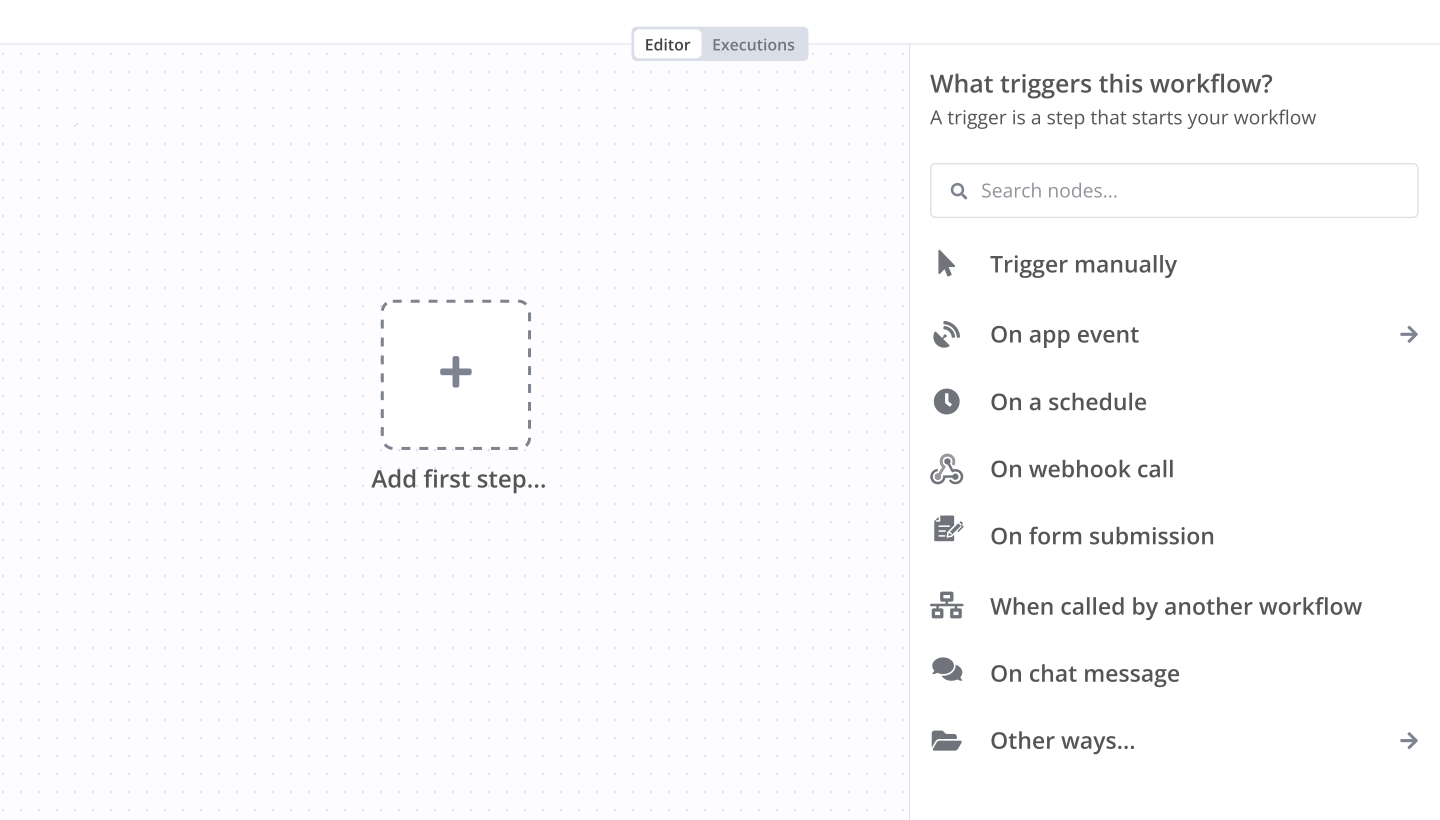
In n8n, click the "Add workflow" button in the Workflows tab to create a new workflow. Add the starting point – a trigger on when your workflow should run: an app event, a schedule, a webhook call, another workflow, an AI chat, or a manual trigger. Sometimes, the HTTP Request node might already serve as your starting point.
Build your own Caspio and Google Vertex AI integration
Create custom Caspio and Google Vertex AI workflows by choosing triggers and actions. Nodes come with global operations and settings, as well as app-specific parameters that can be configured. You can also use the HTTP Request node to query data from any app or service with a REST API.
What can you do with Caspio?
Delete
Delete files from an attachment field
Download
Download files from an attachment field
Get Properties
Returns file properties stored in an attachment field
Upload
Upload a file to an attachment field
Get Many
Returns the list of data import/export tasks
Run
Run a chosen data import export task
Activate User
Activate a user in a directory
Create User
Create a new user in a directory
Delete User
Delete users from a directory
Get Many Directories
Returns the list of directories
Get Many Users
Returns the list of users in a directory
Update User
Update a user in a directory
Delete
Delete a file from Files area
Download
Download a file from Files area
Get File Properties
Returns file properties from Fiels area
Get Folder Properties
Returns folder properties from Files area
Upload
Upload a file to Files area
Create
Create a new record in a table
Delete
Delete a record from a table
Get Many
Returns records from a table or a view
Update
Update a record in a table
Supported API Endpoints for Google Vertex AI
POST
Generate content
This endpoint generates content based on the input provided.
/vertex-ai/generative-ai/docs/model-reference/inference
POST
Call function
This endpoint allows for calling functions as part of the generative tasks.
/vertex-ai/generative-ai/docs/model-reference/function-calling
POST
Ground content
This endpoint grounds the content to ensure relevance and context.
/vertex-ai/generative-ai/docs/model-reference/grounding
GET
List API errors
This endpoint retrieves potential API errors that can occur during requests.
/vertex-ai/generative-ai/docs/model-reference/api-errors
POST
Generate text embeddings
This endpoint generates embeddings for given text inputs.
/vertex-ai/generative-ai/docs/model-reference/text-embeddings-api
POST
Generate multimodal embeddings
This endpoint generates embeddings that leverage multiple modalities.
/vertex-ai/generative-ai/docs/model-reference/multimodal-embeddings-api
POST
Generate and edit images
This endpoint is used for generating and editing images based on input specifications.
/vertex-ai/generative-ai/docs/model-reference/imagen-api
GET
Use code completions
API for generating code completion suggestions.
/vertex-ai/generative-ai/docs/model-reference/code-completion
GET
Perform batch predictions
API for executing batch predictions on data.
/vertex-ai/generative-ai/docs/model-reference/batch-prediction-api
POST
Batch prediction
API for performing batch prediction.
/vertex-ai/generative-ai/docs/model-reference/batch-prediction-api
GET
Tune models
API for tuning machine learning models.
/vertex-ai/generative-ai/docs/model-reference/tuning
POST
Tuning model parameters
API for tuning model parameters.
/vertex-ai/generative-ai/docs/model-reference/tuning
GET
Rapid evaluation
API for quickly evaluating model performance.
/vertex-ai/generative-ai/docs/model-reference/evaluation
POST
Evaluate model performance
API for rapid evaluation of models.
/vertex-ai/generative-ai/docs/model-reference/evaluation
GET
Use LlamaIndex
API for accessing the LlamaIndex for retrieval-augmented generations.
/vertex-ai/generative-ai/docs/model-reference/rag-api
GET
Manage extensions
API for managing custom extensions.
/vertex-ai/generative-ai/docs/model-reference/extension
POST
Manage extensions
API for handling extensions.
/vertex-ai/generative-ai/docs/model-reference/extension
GET
Count tokens
API for counting tokens in text inputs.
/vertex-ai/generative-ai/docs/model-reference/count-tokens
GET
Use reasoning engine
API for performing reasoning tasks.
/vertex-ai/generative-ai/docs/model-reference/reasoning-engine
POST
Utilize reasoning engine
API for using the reasoning engine capabilities.
/vertex-ai/generative-ai/docs/model-reference/reasoning-engine
GET
Use MedLM API
API for accessing medical language models.
/vertex-ai/generative-ai/docs/model-reference/medlm
POST
Access MedLM
API for accessing MedLM functionality.
/vertex-ai/generative-ai/docs/model-reference/medlm
POST
Generate and edit images
API for generating and editing images.
/vertex-ai/generative-ai/docs/model-reference/code-completion
POST
Access LlamaIndex
API for accessing LlamaIndex functionality.
/vertex-ai/generative-ai/docs/model-reference/rag-api
POST
Count tokens
API for counting tokens in text.
/vertex-ai/generative-ai/docs/model-reference/count-tokens
To set up Google Vertex AI integration, add the HTTP Request node to your workflow canvas and authenticate it using a generic authentication method. The HTTP Request node makes custom API calls to Google Vertex AI to query the data you need using the API endpoint URLs you provide.
See the example hereThese API endpoints were generated using n8n
n8n AI workflow transforms web scraping into an intelligent, AI-powered knowledge extraction system that uses vector embeddings to semantically analyze, chunk, store, and retrieve the most relevant API documentation from web pages. Remember to check the Google Vertex AI official documentation to get a full list of all API endpoints and verify the scraped ones!
Caspio and Google Vertex AI integration details
Google Vertex AI
Google Vertex AI is a unified machine learning platform that enables developers to build, deploy, and manage models efficiently. It provides a wide range of tools and services, such as AutoML and datasets, to accelerate the deployment of AI solutions.
Related categories
FAQs
FAQ
AI agents and workflows for technical teams at


Why use n8n to integrate Caspio with Google Vertex AI
Build complex workflows, really fast