See llms.txt for all machine-readable content.
Back to integrations
Integrate EAD Enterprise Suite with 1000+ apps and services
Unlock the full potential of EAD Enterprise Suite and n8n’s automation platform by connecting g-digital by Garrigues’s capabilities with over 1,000 apps, data sources, services, and n8n’s built-in AI features.
Need something that’s not covered yet?
Use n8n’s pre-authenticated HTTP Request node to create new connections, giving you the flexibility to build powerful automations on any stack.


Created by
g-digital by Garrigues
Last update
a month ago
EAD Enterprise Suite integration
is built and maintained by our partners at g-digital by Garrigues and verified by n8n. That means it’s solid, safe, and ready to help you tap into some great capabilities.
About EAD Enterprise Suite
EAD Enterprise Suite is a modular platform of digital trust services designed to bring legally robust, traceable and auditable capabilities into corporate processes, document workflows and business applications.
The suite enables organisations to digitise critical interactions with a higher level of assurance, covering the full lifecycle of a trusted digital transaction: document preparation, electronic signature, certified notification, evidence generation, timestamping, custody, auditability and long-term preservation of the final deliverables.
A key differentiating factor of EAD Enterprise Suite is that its infrastructure is hosted in a European sovereign cloud environment, helping organisations address regulatory, data residency, security and operational resilience requirements. This makes it especially relevant for regulated industries, legal environments, financial services, public sector-related processes and organisations that need to maintain control over sensitive information within a European trust framework.
Core products
Signature Manager allows organisations to orchestrate advanced electronic signature processes with full traceability. It supports structured signing flows, sequential or parallel signature orders, multiple signers, validators, observers, document packages and detailed status monitoring. It is designed for complex approval and signing processes where evidence, control and auditability are as important as the signature itself.
Notice Manager enables the delivery of certified communications through digital channels such as email, WhatsApp, SMS/RCS or other integrated channels. It provides evidence of the communication process, including sending, delivery, access, reading or other relevant events depending on the channel. This allows organisations to replace informal or weak communication flows with certified, traceable and legally stronger interactions.
eArchiving provides secure digital custody and preservation of documents, evidence packages, signed files, metadata and transaction records. It is designed to safeguard the final outcome of a trusted digital process, generating custody certificates and maintaining the evidentiary value of documents and associated metadata over time.
Together, these products provide a complete trust layer for digital business processes: sign, notify, evidence and preserve.
Integration with n8n
EAD Enterprise Suite can be used from n8n as a set of trusted automation building blocks. Through APIs, webhooks and, where applicable, MCP-based integrations, n8n workflows can invoke EAD Enterprise Suite services to embed digital trust capabilities into automated business processes.
This means that an n8n workflow could automatically create a signature request, send a certified notification, archive a signed document, retrieve evidence, update a CRM or DMS, and trigger follow-up actions based on the certified result of the process.
Related categories

What can you do with EAD Enterprise Suite?
Create Case File
Creates a new case file — the top-level container for all related operations (evidence, notifications, signatures, dossiers). Call this first before any other operation. Generate a UUID v4 for `ID`. Returns caseFileId needed for all subsequent calls.
Delete Case File
Deletes a case file and everything filed inside it — evidence groups, dossiers, notifications and their certificates. Irreversible, with no confirmation step and no recycle bin. Requires: caseFileId. Returns no body (HTTP 204); confirm with case_file_list. Do not call it to 'clean up' unless the user asked for that case file to be destroyed.
Get Case File
Retrieves details of a specific case file. Requires: caseFileId. Use to verify a case file exists before creating evidence groups, dossiers, or signature requests.
List Case File
Lists all case files in your EAD Enterprise Suite account. Pass userId (from session_login or session_info) to scope results to your account. Returns paginated list with IDs, names, and status.
Certify Dossier
Certifies a dossier, generating a tamper-evident PDF and locking all linked evidence. Requires: dossier_create → dossierId, dossier_evidence_link (evidence linked), case_file_create → caseFileId. ASYNC: transitions DRAFT → CERTIFYING → CERTIFIED. Poll dossier_list until dossierId status === CERTIFIED.
Certify Dossier Group
Creates AND certifies a dossier from a single sealed evidence group in one call (express path). Requires: evidence_seal (CLOSED), case_file_create → caseFileId, evidence_group_create → evidenceGroupId. Generate a UUID v4 string for `ID`. Returns dossierId with CERTIFYING status → poll until CERTIFIED.
Create Dossier
Creates a dossier to aggregate certified evidence groups into a single tamper-evident PDF. Requires: case_file_create → caseFileId. Evidence groups must be in CLOSED status before linking. Generate a UUID v4 string for `ID`. Returns dossierId. After creation, link evidence with dossier_evidence_link, then certify with dossier_certify.
Delete Dossier
Deletes a dossier. Available in DRAFT status (to discard before certification) or in CERTIFIED status (to permanently remove the certified dossier). Irreversible. Requires: caseFileId and dossierId.
Dossier Document Url
Returns the download URL for the certified dossier PDF. Requires: dossier_certify (CERTIFIED status), caseFileId, dossierId.
Dossier List By User
Lists every dossier belonging to a user, across all of their case files. Requires: userId (from session_login or session_info). Use this when you do not know which case file a dossier is in; use dossier_list when you already have a caseFileId. Supports filter, order and page. Returns { data, meta.totalElements }.
Dossier Package Url
Returns the download URL for the full dossier package (PDF + evidence files). Requires: dossier_certify (CERTIFIED status), caseFileId, dossierId.
Dossier Visibility
Updates the visibility (public/private) of a certified dossier. Requires: dossier_certify (CERTIFIED status), caseFileId, dossierId.
Get Dossier
Retrieves full details of a specific dossier including status, linked evidence, and download URLs. Requires: caseFileId and dossierId.
List Dossier
Lists all dossiers in a case file. Requires: caseFileId. Returns paginated list with IDs, names, status, and creation dates. Use to monitor certification progress — poll until status: CERTIFIED.
List Dossier Template
Lists available dossier templates. No prerequisites. Returns template IDs and their translations per language. Use the returned ID as dossierTemplateId in dossier_create.
Preview Dossier
Returns an HTML preview URL of a dossier before certification. Requires: caseFileId and dossierId.
Update Dossier
Updates the metadata of an existing dossier. Requires: dossier_create → dossierId, caseFileId. Only available while dossier is in DRAFT status.
Delete Dossier Evidence
Removes an evidence item from a dossier. Only available while dossier is in DRAFT status. Requires: caseFileId, dossierId, evidenceId.
Dossier Evidence List By Dossier
Lists every evidence item linked to a dossier, across all of its evidence groups. Requires: caseFileId and dossierId. This is the dossier-wide view; dossier_evidence_list is the narrower per-group one and additionally needs a dossierEvidenceGroupId. Supports filter, order and page. Returns { data, meta.totalElements }.
Dossier Evidence List To Link
Lists evidence items available to be linked to a dossier (CLOSED groups not yet linked). Requires: caseFileId and dossierId.
Get Dossier Evidence
Retrieves details of a specific evidence item linked to a dossier. Requires: caseFileId, dossierId, evidenceId.
Link Dossier Evidence
Links evidence items from a sealed group to a dossier. Requires: dossier_create → dossierId, evidence_seal (CLOSED), case_file_create → caseFileId. Pass the IDs array of evidence UUIDs. Can be called multiple times for evidence from different case files.
List Dossier Evidence
Lists the evidence items linked to ONE evidence group of a dossier. Requires: caseFileId, dossierId AND dossierEvidenceGroupId — all three are mandatory. For every evidence item in the dossier regardless of group, use dossier_evidence_list_by_dossier instead. Supports filter, order and page.
Complete Large Evidence Upload
Finalize a multipart evidence upload and register the evidence in the group. Returns immediately — the evidence transitions asynchronously to COMPLETED. Poll evidence_list until status is COMPLETED before sealing the group.
Create Evidence
Registers a NEW evidence record inside an evidence group. Requires: evidence_group_create → evidenceGroupId, case_file_create → caseFileId. Generate a UUID v4 for `ID`. Compute the SHA-256 hex hash of the file BEFORE calling. Normal INTERNAL flow: call evidence_create with custodyType INTERNAL and NO fileUrl; the API returns uploadFileUrl, a presigned S3 URL. You MUST PUT the exact file bytes to uploadFileUrl, then verify with evidence_get/evidence_list, and ONLY THEN call evidence_seal. Do not seal an evidence group until every INTERNAL evidence file has been uploaded. Convenience flow: if you pass `fileUrl` (public HTTPS, no redirects, under 1 GiB), this tool downloads that URL and PUTs the bytes to uploadFileUrl for you. EXTERNAL flow: use custodyType EXTERNAL only when you intentionally register hash-only evidence; still generate a fresh UUID for each evidence. If an INTERNAL evidence creation/upload failed and you want to retry as EXTERNAL, create a NEW evidence ID; do not reuse an ID whose outcome is unknown. WARNING: the API sometimes returns {code:'EvidenceCreateError'} even when the evidence was successfully persisted — always verify with evidence_list before retrying.
Create Evidence Group
Creates an evidence group inside a case file. Requires: case_file_create → caseFileId. Generate a UUID v4 for `ID`. Set evidenceType to FILE, PHOTO, VIDEO, or WEB_PLUGIN. Returns evidenceGroupId. One group can contain multiple evidence records.
Get Evidence
Retrieves a specific evidence record. Requires: evidence_create → evidenceId, evidence_group_create → evidenceGroupId, case_file_create → caseFileId. Returns status (COMPLETED|IN_PROCESS|ERROR), hash, and tspTimestamp when certified.
Get Large Evidence Upload
Reports how much of a large evidence upload the platform has actually received. Requires: caseFileId, evidenceGroupId and the evidence ID. Returns fileName, totalSizeMB, chunkSizeMB and biggestUploadedOffset — compare biggestUploadedOffset against totalSizeMB to decide whether every part landed before calling large_evidence_upload_complete. Use it to resume or diagnose a stalled upload.
Initiate Large Evidence Upload
Performs the large_evidence_upload_initiate operation against the GoCertius API. Review the API documentation for full field details.
List Evidence
Lists all evidence records in a specific evidence group. Requires: caseFileId and evidenceGroupId. Returns paginated list with IDs, titles, status, and timestamps.
List Evidence Group
Lists all evidence groups in a case file with their current status (OPEN, CLOSING, CLOSED). Use to find an existing group or check which groups are ready for sealing. Requires: caseFileId.
Seal Evidence
Seal and certify an evidence group. Closes the group to new additions and triggers async timestamping. Returns immediately — the group transitions OPEN → CLOSING → CLOSED. Poll evidence_group_list until status is CLOSED before linking to a dossier.
Create ID Verification Video
Starts a REMOTE VIDEO identity verification for one person: the platform contacts them and runs the identification session. Requires: ID (UUID v4 you generate), name, firstSurname, email, phonePrefix and phoneNumber. phonePrefix must include the leading + (for example '+34'). secondSurname is optional. Returns HTTP 201 with NO body, so keep the ID you generated — it is the verificationId, and id_verification_list is the only way to read the outcome. PERMIT-GATED: call profile_get first and check permit.idVerifications; if it is false every call here returns 403 with code NoIdVerificationsPermit and no argument change will help, so report it rather than retrying. Presential (in-person) identity verification is deprecated upstream and deliberately not exposed.
ID Verification Contract Url
Retrieves the signed identity-verification contract for one completed verification. Requires: verificationId — the ID you generated for id_verification_video_create, or an ID from id_verification_list. NOTE: the OpenAPI specification declares a 200 response with NO body for this operation, so the exact payload is undeclared and has not been observed against a working deployment; inspect what comes back rather than assuming a particular field. PERMIT-GATED: returns 403 with code NoIdVerificationsPermit when profile_get reports permit.idVerifications === false. Signing the contract requires two live OTPs and is deliberately not exposed as a tool.
List ID Verification
Lists the identity verifications belonging to a user, with the outcome of each. Requires: userId (from profile_get). Items are { ID, email, name, firstSurname, secondSurname, status, identificationType, createdAt, createdBy, rejectedReason, rejectedContext }, so this is where you read whether a verification succeeded and, when it did not, why. Supports filter, order and page. This is the only way to observe an id_verification_video_create, which returns no body. PERMIT-GATED: returns 403 with code NoIdVerificationsPermit when profile_get reports permit.idVerifications === false.
Add Notification Document
Attaches a document to a notification. Two steps: this call registers the file and returns { URL }, a presigned upload URL, and you then PUT the raw bytes to that URL with an x-amz-checksum-sha256 header. Generate a UUID v4 for `ID`, and compute the file's SHA-256 hex hash BEFORE calling — it goes in `hash`. ORDER MATTERS AND GETTING IT WRONG FAILS THE SEND: add every document BEFORE adding recipients, and wait until each document reaches READY_TO_SEND (poll notification_document_list; roughly 8 seconds) before calling notification_request_send. Attaching after recipients, or sending while a document is still PENDING, returns 409/404 NOTIFICATION_NOT_FOUND. The maximum number of attachments is a per-subscription setting rather than a fixed API limit, so do not assume a number. Attachments can be bundled into the delivery certificate — see notification_certificate_package_url.
Add Notification Receiver
Adds a recipient to a notification request. Requires: notification_request_create → notificationRequestId, case_file_create → caseFileId. The `ID` can be a UUID v4 or custom string. Returns receiverId — save it for notification_certificate_get. Delivery is by email always; set sendWaUrl for a WhatsApp link, sendSmsUrl for an RCS/SMS link (the channel negotiates: RCS where the handset supports it, SMS otherwise), and otpRequired to challenge the recipient with a one-time code. Any of those three needs phonePrefix (with the +) and phoneNumber. Add all receivers before calling notification_request_send — but if the notification has attachments, add those FIRST (see notification_document_add).
Create Notification Request
Creates a certified notification request. Requires: case_file_create → caseFileId. Generate a UUID v4 for `ID`. Set language to en_GB or es_ES. Returns notificationRequestId. Add at least one receiver with notification_receiver_add before sending. IMPORTANT: The `content` field must be valid HTML — plain text without HTML tags will not render on the recipient landing page. Only the following HTML formats are supported: paragraphs (<p>), bold (<strong>), italic (<em>), unordered lists (<ul><li>), ordered lists (<ol><li>). Do not use other HTML tags or CSS. Avoid special typographic characters (em dashes, smart quotes) in `subject`; use standard ASCII equivalents (hyphen, straight quotes) instead.
Delete Notification Document
Removes an attachment from a notification. Requires documentId (from notification_document_list), notificationRequestId and caseFileId.
Delete Notification Receiver
Removes a recipient from a notification. Requires receiverId, notificationRequestId and caseFileId. To remove every address the platform rejected in one call, use notification_receiver_invalid_purge rather than deleting them one by one.
Delete Notification Request
Deletes a notification. Requires notificationRequestId and caseFileId. There is no undo. TESTED: once the notification has been sent the API rejects this with 403 Forbidden — a sent notification is delivery evidence and cannot be removed. If you only want it filed elsewhere, use notification_request_case_file_move instead.
Get Notification Certificate
Creates or retrieves a PDF certificate for a specific notification receiver. Requires notification_request_send and notification_receiver_add. Generate a UUID v4 for `ID` the first time and reuse that ID when polling. This tool is idempotent: it first lists existing certificates for the receiver and, if `ID` already exists, returns it instead of creating it again. If the certificate status is CERTIFIED, the response includes documentUrl when available. If it is CERTIFYING, poll this same tool with the same ID.
List Notification Certificate
Lists the delivery certificates already generated for one recipient, so you can reuse one instead of generating a duplicate. Requires receiverId, notificationRequestId and caseFileId. Returns per certificate: ID, status (DRAFT, CERTIFYING, CERTIFIED), language, createdAt, certifiedAt, `partial` — whether it is an intermediate certificate issued before the recipient finished responding — and `embeddedDocuments`. Do not read `embeddedDocuments` as "the package contains the attachments": in a tested run it was false on a notification that had an attachment, and notification_certificate_package_url still returned a ZIP carrying that attachment. Once a certificate is CERTIFIED, download it with notification_certificate_document_url (the certificate alone) or notification_certificate_package_url (a ZIP that also carries the attachments).
List Notification Document
Lists the documents attached to a notification with their processing status, and it is what you poll after notification_document_add: a newly registered document starts at PENDING and reaches READY_TO_SEND in roughly 8 seconds. Calling notification_request_send while any document is still PENDING fails with 409/404 NOTIFICATION_NOT_FOUND. Poll with a bounded retry — every few seconds, a dozen attempts at most. Requires notificationRequestId and caseFileId. Paginated.
List Notification Receiver
Lists a notification's recipients with their individual delivery state. Returns per recipient: ID, firstName, lastName, email, phonePrefix/phoneNumber, status (INVALID, READY_TO_SEND, SENT, READ, ANSWERED, ERROR), statusUpdatedAt, `answer` once they respond, emailBounced, and validationError (TAKEN, IS_DEFINED, IS_INVALID) for a rejected address. Worth calling before notification_request_send to see whether any address came back INVALID, and after sending to see who read or answered. Also the way to recover a receiverId for notification_certificate_get. Paginated; filterable by ID.
List Notification Request
Lists the certified notifications visible to a user. Requires userId (from session_login, session_info or profile_get) — this listing is user-scoped, not case-file-scoped, so it spans every case file unless you filter. Use this to recover a notificationRequestId you no longer have; it is the only way to find one. Returns per notification: ID, code, subject, status, type, sentAt, receiverStats and the owning caseFile. Filter by `status` or `statuses` (CREATING, DRAFT, IN_PROCESS, SENT, PARTIALLY_READ, FULLY_READ, PARTIALLY_ANSWERED, FULLY_ANSWERED), by `caseFileIds`, by `search` over the subject, or by `receiversSearch` to find the notification sent to a given recipient. Paginated.
Notification Certificate Document Url
Returns { documentUrl } for the certificate PDF on its own, WITHOUT the attachments. Requires certificateId, receiverId, notificationRequestId and caseFileId. Wait until the certificate is CERTIFIED: generation is asynchronous and the first call can 404 or come back empty while it is still CERTIFYING, so poll a few times with a bounded retry rather than hammering it. If you want the attachments bundled in, use notification_certificate_package_url instead.
Notification Certificate Package Url
Returns { packageUrl } for a ZIP containing the certificate AND the notification's attachments — the "with annexes" form. There is no separate preview flag anywhere in the API: the package carries the annexes, the document is the certificate alone. Requires certificateId, receiverId, notificationRequestId and caseFileId. Same preconditions as notification_certificate_document_url — wait for CERTIFIED, and expect the first call to fail while generation is still running.
Notification Document Download Url
Returns { downloadUrl }, a temporary link to an attachment as it was sent. Requires documentId (from notification_document_list), notificationRequestId and caseFileId. Use it to retrieve a file you attached or to verify what a recipient received. The URL is presigned and expires — fetch it when you need it rather than storing it.
Notification Receiver Add Bulk
Adds several recipients in one call instead of one notification_receiver_add per person. Pass `receivers` as an array; each entry needs `ID` (you generate it), firstName, lastName and email, and may carry phonePrefix (with the +) and phoneNumber. Note this bulk form does NOT accept the per-recipient otpRequired, sendWaUrl or sendSmsUrl flags that the single-recipient tool does — set the defaults on the request instead (otpByDefault, sendWaUrlByDefault, sendSmsUrlByDefault). The maximum number of recipients is a per-subscription setting, not a fixed API limit: it varies by tenant and platform, so do not assume a number — add them and read the error if the tenant's cap is exceeded. Add every recipient before calling notification_request_send, then check the result with notification_receiver_list, since a rejected address appears with status INVALID.
Notification Receiver Invalid Purge
Removes every recipient whose status is INVALID — addresses the platform rejected as malformed or duplicated — from a notification in a single call. Requires notificationRequestId and caseFileId. Recipients in any other status are left untouched. AN INVALID RECIPIENT BLOCKS THE SEND, so run this (or fix the addresses with notification_receiver_update) before notification_request_send, or the notification will not go out. Use notification_receiver_list first to see what will go.
Notification Request Case File Move
Moves a notification to a different case file. Note the two caseFileId values: the one in the path is where the notification is NOW, and the one in the body is the destination. Notifications are grouped by case file, and this is the only way to change that grouping without duplicating.
Notification Request Duplicate
Creates a new DRAFT notification from an existing one, copying its content, its recipients and its attachments. Works whatever state the original is in, so this is how you resend to the same people or reuse a sent notification as a template. Generate a UUID v4 for `ID` and supply a new `subject`; pass `caseFileId` in the body to place the copy in a different case file, or omit it to keep it alongside the original. THE COPY IS BUILT ASYNCHRONOUSLY: it starts in CREATING with zero recipients and zero documents, and fills in afterwards, so reading it immediately shows an empty notification that is not empty. Poll notification_request_status until the status is DRAFT before inspecting or sending it. Because recipients ARE copied, review them with notification_receiver_list before calling notification_request_send — otherwise you will send to the original list again.
Notification Request Status
Checks the delivery status of a certified notification. Requires: notificationRequestId, caseFileId. Returns status (CREATING|DRAFT|IN_PROCESS|SENT|PARTIALLY_READ|FULLY_READ|PARTIALLY_ANSWERED|FULLY_ANSWERED). Poll until status is SENT or beyond. Do not call notification_certificate_get while status is CREATING, DRAFT, or IN_PROCESS.
Send Notification Request
Trigger delivery of a certified notification to all added recipients. Returns immediately — delivery is async. Poll notification_request_status until status is DELIVERED before retrieving certificates.
Update Notification Receiver
Corrects a recipient's details: firstName, lastName, email, phonePrefix, phoneNumber. Requires receiverId, notificationRequestId and caseFileId. Use this to fix a mistyped address rather than deleting and re-adding, which would lose the receiverId. phonePrefix must include the + (for example +34). A phone number is required if the recipient is to receive the RCS/SMS link (sendSmsUrl), the WhatsApp link (sendWaUrl), or an OTP challenge (otpRequired).
Update Notification Request
Edits a notification that has not been sent: subject, content, type and language. Requires notificationRequestId and caseFileId. `content` must be valid HTML — plain text is accepted by the API but does NOT render on the recipient landing page. Supported tags only: <p>, <strong>, <em>, <ul><li>, <ol><li>; no other tags and no CSS. Keep `subject` to plain ASCII (no em dashes, no smart quotes), 100 characters maximum. TESTED: once the notification has been sent the API rejects this with 403 Forbidden, so editing only works before the send. To change which case file it belongs to use notification_request_case_file_move — this tool does not move it.
Get Profile
Returns the authenticated user's own profile. It identifies the caller from the session token alone — no email or any other input needed — so it works on every deployment, including a per-request Bearer one. Its `ID` field IS your userId (UUID): the value required by case_file_list and every /users/{userId}/... operation. Prefer this over session_info when you need the userId: it is the canonical source. Also returns companyId (needed to subscribe to the notifications SSE stream) and defaultCaseFileId. Also returns `permit`, a set of booleans — { evidences, idVerifications, notifications, chats, signatures } — that says which tool families this account may use at all: a false entry means every tool in that family returns 403 regardless of inputs, and no retry or different argument will help. Read it before calling into a family for the first time; on the integration deployment checked on 2026-09-07, permit.idVerifications was false and every identity tool returned 403 NoIdVerificationsPermit. No parameters.
Login Session
Force the EAD Enterprise Suite MCP server to re-authenticate. Takes no parameters and accepts no credentials: the server re-exchanges the user key it was configured with (MCP_AUTH_USER_KEY) for a fresh session token, and this tool reports the resulting userId and expiry. The server manages authentication automatically — call this only to force a re-login or after a 401.
Activate Signature Request
Activates a signature request, transitioning from DRAFT to ACTIVE and sending signing invitations to all signatories. Do NOT call this immediately after uploading files. Activation preconditions: request is DRAFT; at least one SIGNATORY exists; every document has been uploaded to its presigned URL; backend processing has had time to complete for every uploaded document (use processed/READY_TO_SIGN from signature_request_get when exposed; otherwise wait after the successful PUT); and PDF documents have signature coordinates set for every required signatory. INTERPOSITION may send a simple signing link, including WhatsApp when available/configured; ADVANCED uses phonePrefix/phoneNumber for OTP and currently does not support WhatsApp delivery. IRREVERSIBLE: cannot add documents or participants after activation. ASYNC: after activation, poll signature_request_get until status is ACTIVE, then use signature_document_signatory_list with documentId to monitor each signatory, or signature_document_list for the request's documents and their aggregate signatoryStatusStats; call signature_certificate_get only after the document is SIGNED.
Assign Validator To Signatory
Assigns one or more validators to a specific signatory in a signature request. The validator must approve before the signatory can sign. Requires: signature_participant_create (validator) → validatorId in validatorIds array, signature_participant_create (signatory) → signatoryId, signature_request_create → requestId, case_file_create → caseFileId.
Cancel Signature Request
Cancels an active signature request. Requires: activate_signature_request (ACTIVE status), requestId, caseFileId. Transitions to CANCELLED. Cannot be undone.
Create Signature Group
Creates a signing order group for a CONFIGURABLE signature request. Types: 'Document' (groups documents into signing rounds — use its ID as groupId in signature_request_add_document), 'Signatory' (groups signatories into signing rounds — use its ID as groupId in signature_participant_create), 'DocumentSignatory' (links a specific document to a signing round, requires documentId). IMPORTANT — avoid empty groups: when a CONFIGURABLE request is created, the API automatically pre-creates one Document group and one Signatory group both at index:1. Always use these pre-existing index:1 groups for your first document and first signatory (retrieve their IDs with signature_group_list immediately after creating the request). Only call signature_group_create for the ADDITIONAL groups (index:2, 3…). Add participants with linkToAllDocuments:true so DocumentSignatory groups are auto-generated at the correct index. Adding participants without linkToAllDocuments leaves them unlinked to documents and signature_coordinate_set will fail with 'Signatory not found'.
Create Signature Participant
Adds one participant to a DRAFT signature request. This is the ONLY participant create endpoint: `role` selects SIGNATORY (must sign), OBSERVER (receives a read-only copy) or VALIDATOR (must approve before its signatory can sign). Requires: signature_request_create → requestId, case_file_create → caseFileId, plus role, firstName, lastName and email. YOU generate `ID` (UUID v4) and the call returns HTTP 201 with NO body, so nothing is handed back — the ID you generated IS the participantId, and it is the signatoryId if you passed role SIGNATORY or the validatorId if you passed role VALIDATOR. Keep it. For ADVANCED signatures phonePrefix and phoneNumber are mandatory because the signer receives the OTP there, and WhatsApp delivery is NOT supported for ADVANCED; for INTERPOSITION phone is optional and WhatsApp is available when the platform is configured for it. Add at least one SIGNATORY before activating. For role VALIDATOR do NOT include groupId or linkToAllDocuments — link it afterwards with assign_validator_to_signatory. Use signature_participant_add_bulk to add many at once, and signature_participant_list to re-read what exists.
Create Signature Request
Creates a new signature request in DRAFT status. Requires: case_file_create → caseFileId. Generate a UUID v4 for `ID`. Set deadline as ISO 8601 datetime (max ~30 days ahead). Returns requestId. Add documents with signature_request_add_document and participants with signature_participant_create before activating.
Delete Signature Participant
Removes one participant from a signature request. Requires: signature_participant_create → participantId, signature_request_create → requestId, case_file_create → caseFileId. Use it to drop someone added by mistake, or to change a role (delete, then create again with the new role, since role is not updatable). Returns no body; confirm with signature_participant_list. To drop every invalid participant at once use signature_participant_invalid_purge instead.
Get Signature Certificate
Retrieves the signed document certificate PDF. Requires: activate_signature_request (document fully SIGNED), signature_request_add_document → documentId, signature_request_create → requestId, case_file_create → caseFileId. Returns documentUrl (signed PDF certificate). ASYNC: poll until documentUrl is available.
Get Signature Request
Retrieves full details of a signature request. Requires: signature_request_create → requestId, case_file_create → caseFileId. Returns status, documents, participants, deadline, and history. Use to check overall process state.
List Signature Document
Lists the documents of a signature request with a document-level status and per-document statistics. Requires: signature_request_create → requestId, case_file_create → caseFileId. Items are { ID, requestId, groupId, status, title, fileName, fileSize, convertToPdf, participantStats, signatoryStatusStats, signatoryCoordinatesStats } — for example status PARTIALLY_SIGNED with signatoryStatusStats { pending: 0, readyToSign: 1, signed: 1, rejected: 0 } and signatoryCoordinatesStats { defined: 2, missing: 0 } (live-read on INT 2026-09-07). signatoryCoordinatesStats.missing === 0 is the direct check that every required signatory has coordinates before activate_signature_request. Whether this status also reports upload processing for a freshly added document is NOT verified — keep using signature_request_get for that. For the signatories of one document use signature_document_signatory_list.
List Signature Document Observer
Lists the OBSERVERS of one document in a signature request — participants created with role OBSERVER, who receive a copy but never sign. Requires: signature_request_add_document → documentId, signature_request_create → requestId, case_file_create → caseFileId. Items carry only { ID, email, firstName, lastName }: there is deliberately no status field, because an observer has nothing to complete. For the signers of the same document use signature_document_signatory_list.
List Signature Document Signatory
Lists the SIGNATORIES of one document in a signature request, with each signatory's status on that document. Requires: signature_request_add_document → documentId, signature_request_create → requestId, case_file_create → caseFileId. Items are { ID, groupId, email, firstName, lastName, status, coordinates, uniqueValidator, phonePrefix, phoneNumber, participantStats } and status is PENDING, READY_TO_SIGN, VALIDATING, SIGNED or REJECTED. Each `ID` is a signatoryId. To check whether the DOCUMENT itself reached READY_TO_SIGN before activate_signature_request, use signature_request_get; after activation poll here until every signatory is SIGNED before signature_certificate_get.
List Signature Group
Lists all signing order groups of a CONFIGURABLE signature request. Returns ID, type (Document/Signatory/DocumentSignatory), index, and documentId for each group. Call immediately after signature_request_create to retrieve the pre-created index:1 group IDs before adding documents or participants.
List Signature Participant
Lists every participant of a signature request with the role each was created under — SIGNATORY, OBSERVER or VALIDATOR — plus contact details and validity. Requires: signature_request_create → requestId, case_file_create → caseFileId. Items are { ID, requestId, groupId, role, firstName, lastName, email, phonePrefix, phoneNumber, createdAt, editable, emailBounced, valid, validationError, participantStats, documentStats }. This is the tool that resolves IDs: an item's `ID` is the participantId, and it is also the signatoryId when role is SIGNATORY and the validatorId when role is VALIDATOR. Supports filter, order and page.
List Signature Signatory Progress
Lists the documents assigned to ONE signatory of a signature request, with that signatory's progress on each. Requires: caseFileId, requestId and signatoryId. The signatoryId is the `ID` of a participant whose role is SIGNATORY — read it from signature_participant_list or signature_document_signatory_list. Passing a participant ID whose role is not SIGNATORY returns 404 'Signatory not found' — observed on INT 2026-09-07 with a VALIDATOR ID; it is one ID space, but the signatory-scoped endpoints accept only the IDs of SIGNATORY participants. Returns { data, meta.totalElements } with items { ID, fileName, fileSize, status }, where status is PENDING, READY_TO_SIGN, SIGNED or REJECTED.
List Signature Validator
Lists the validators currently linked to ONE signatory of a signature request. Requires: signature_participant_create (signatory) → signatoryId, signature_request_create → requestId, case_file_create → caseFileId. Items carry { ID, email, firstName, lastName }, where each `ID` is a validatorId. Note the two-step model: creating a participant with role VALIDATOR does not attach it to anyone, so a validator can exist on the request and not appear here until assign_validator_to_signatory links it — an empty list means nothing is linked yet, not that no validator exists.
Set Signature Coordinate
Sets the visual position of the signature field on a PDF document page. Required for PDF documents before activation, for both INTERPOSITION and ADVANCED signatures. Requires: signature_participant_create → signatoryId, signature_request_add_document → documentId, signature_request_create → requestId, case_file_create → caseFileId. Provide coordinates as array of {page (1-based), x (points from left), y (points from bottom)}. Set coordinates after the document has been uploaded and before activate_signature_request.
Signature Participant Add Bulk
Adds many participants to a DRAFT signature request in one call instead of one signature_participant_create per person. Requires: signature_request_create → requestId, case_file_create → caseFileId, and a `participants` array whose entries take the same fields as signature_participant_create, including the `ID` and `role` you generate for each. Mixed roles in one call are allowed. Returns HTTP 201 with NO body, so keep the IDs you minted and re-read the result with signature_participant_list.
Signature Participant Invalid Purge
Removes every participant of a signature request that the platform has marked invalid, in one call. Requires: signature_request_create → requestId, case_file_create → caseFileId. signature_participant_list identifies them via `valid: false` and `validationError` — typically an undeliverable email or a malformed phone number. Returns no body; confirm with signature_participant_list. Prefer signature_participant_update when the detail can be repaired rather than the person dropped.
Signature Request Add Document
Adds a document to a DRAFT signature request. Requires: signature_request_create → requestId, case_file_create → caseFileId. Provide a string `ID` for the document. Compute SHA-256 hex hash of the PDF before calling. Optional: pass `fileUrl` (a publicly accessible URL) to have the tool download and upload the file to S3 automatically — no separate PUT needed. If fileUrl is omitted, returns URL (presigned S3 upload URL) for manual PUT. Cannot add documents after activate_signature_request is called. For CONFIGURABLE sequence: `groupId` must reference a Document type group (not Signatory or DocumentSignatory) — passing a wrong group type returns 'Signature group not found'.
Signature Validator Unassign
Unlinks one validator from one signatory, reversing assign_validator_to_signatory. Requires: signature_validator_list → validatorId, signature_participant_create (signatory) → signatoryId, signature_request_create → requestId, case_file_create → caseFileId. This removes the LINK only: the validator remains a participant of the request, so use signature_participant_delete to remove the person entirely. Returns no body; confirm with signature_validator_list.
Update Signature Participant
Corrects a participant's details before the signature request is activated. Requires: signature_participant_create → participantId, signature_request_create → requestId, case_file_create → caseFileId. Any of groupId, firstName, lastName, email, phonePrefix and phoneNumber may be sent. The role CANNOT be changed, so to turn a signatory into an observer, delete it and create it again. Use this to repair a bounced or mistyped email — signature_participant_list reports emailBounced and validationError. Returns no body; confirm with signature_participant_list.
List Use Case
Lists available use cases for the account. Use cases define the allowed signature workflows and document types. Returns useCaseId values needed for signature_request_create.
How to install EAD Enterprise Suite and use it in your n8n workflows
Verified nodes need a quick setup by an instance owner first, but after that, everyone on the instance can start using them in their workflows. Learn more here.
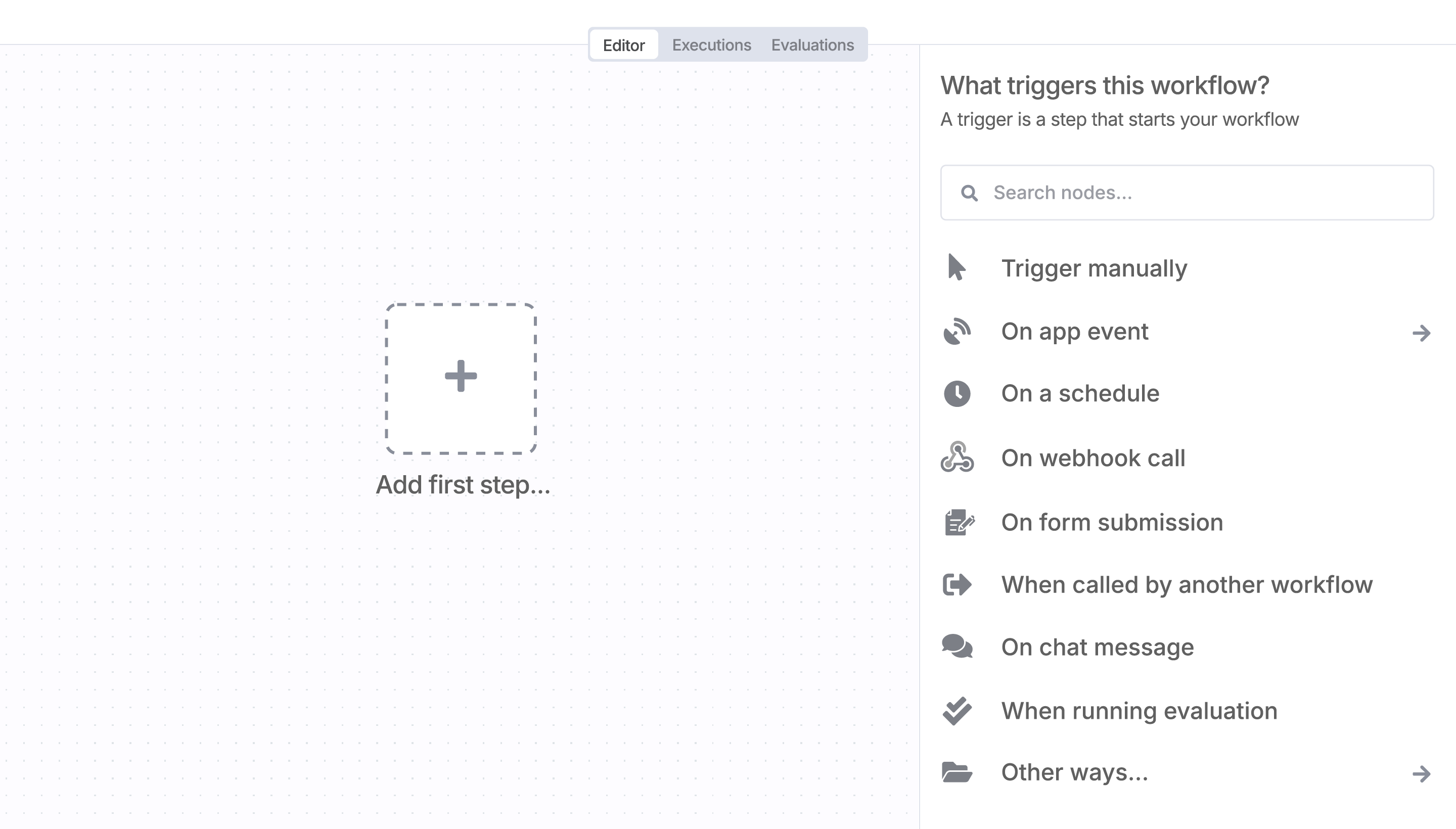
Sign in to n8n, open the editor, and click + in the top right to open the Nodes panel
Resources for EAD Enterprise Suite
AI agents and workflows for technical teams at


