Use n8n when
You need AI to operate inside real workflows with reliability and control.
Use Flowise when
You want to build primarily conversational Agents or provide RAG-driven experiences.
See llms.txt for all machine-readable content.
The difference between n8n and Flowise isn't about which platform has more AI features — it's about what you want AI to do. Flowise is built for creating LLM applications. n8n is built for running AI inside production workflows that connect to the rest of your business.
This n8n vs Flowise comparison examines integration depth, security, and scalability to reveal which offers the best foundation for long-term deployment without vendor lock-in.



You need AI to operate inside real workflows with reliability and control.
You want to build primarily conversational Agents or provide RAG-driven experiences.
Here’s a look at the core differences between the two platforms:
Multi-system workflow and agent orchestration
LLM prototyping and conversational agents
AI as a core infrastructure node
LangChain-centric LLM chain building
1,000+ native SaaS and database nodes
100+ AI-specific tools and vector DBs
Self-hosted (Docker/K8s), cloud
Self-hosted (Docker), cloud
Fair-code (free self-host)/execution-based
Apache 2.0 (free)/tiered cloud
Production-grade, complex operations
Rapid AI experimentation and chatbots
Before diving into specific features, let’s look at the core identity of both platforms and the specific technical challenge they were each designed to solve.

n8n is a source-available workflow automation platform that gives technical teams the precision they need to move data between systems. While it started as a general automation tool, it’s evolved into a strong AI orchestrator with deep system connectivity.
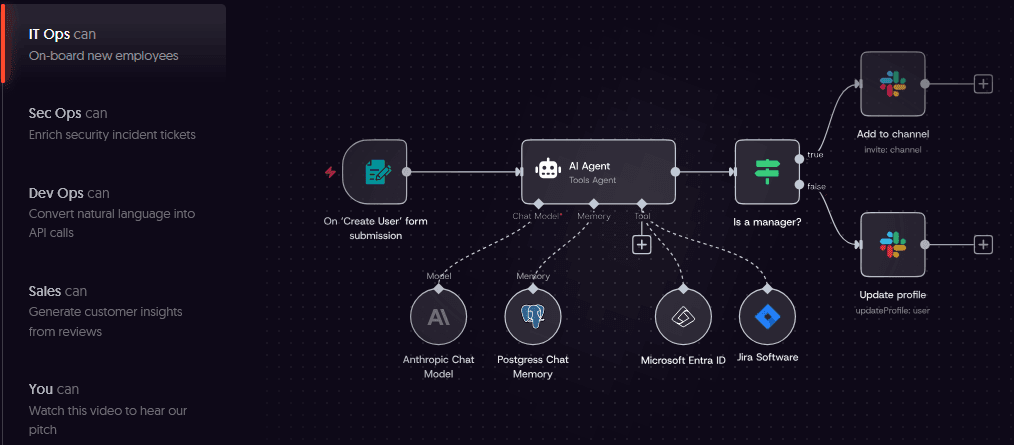
n8n is built for the developer or operator who needs an AI agent to do more than just generate text. It supports complex operations, i.e. where AI must interact with databases. The platform can pull data from a SQL database, check a CRM, and trigger a webhook — all within a single, visible execution path. In n8n, AI is a functional worker in your existing business process.
Flowise is an open-source platform designed specifically for building LLM applications using LangChain.js. Its architectural assumption is that the AI chain is the primary unit of work, making it a highly specialized environment for assembling prompt templates, memory buffers, and retrievers.
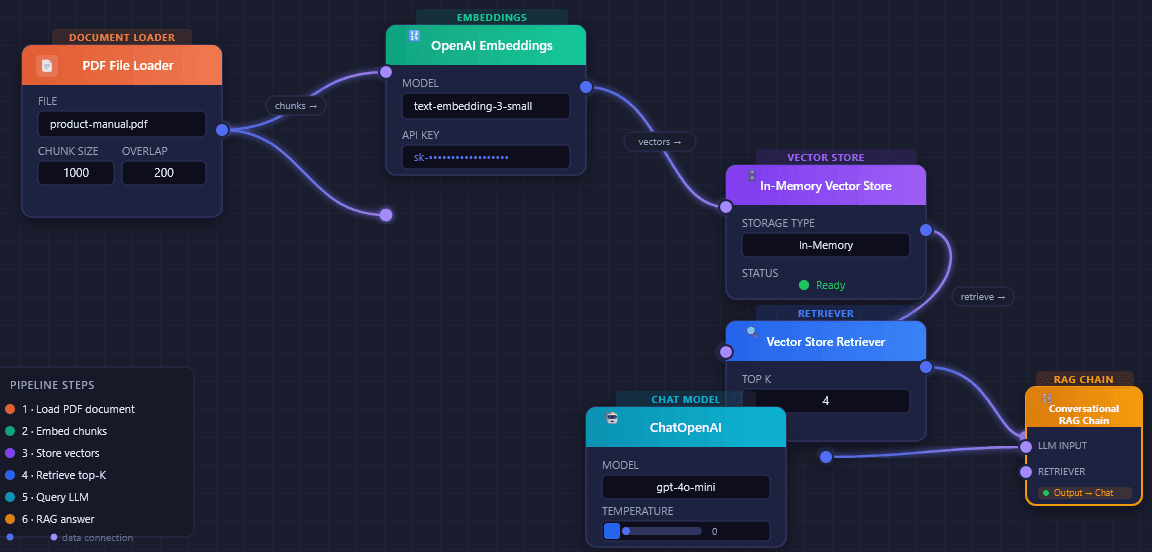
While Flowise provides an accessible UI for building retrieval-augmented generation (RAG) pipelines, it operates as a wrapper around the LangChain ecosystem. This makes it an effective tool for developers who want to stay on the cutting edge of LLM reasoning patterns. But teams must be willing to work within the specific memory and execution constraints of a JavaScript-based implementation.
In a production environment, high-latency tasks create the biggest stability risks. While a standard API call takes milliseconds, a complex LLM reasoning chain can take upwards of 45 seconds. In a single-process architecture, these hanging executions can saturate the event loop, causing webhooks to time out and the editor UI to lag.
n8n solves this via Queue Mode, an architecture that offloads the heavy lifting to independent worker nodes. This separation keeps the UI and triggers responsive, even when the workers are under heavy load.
While Flowise handles LLM reasoning efficiently, its reliance on a long-running. Node.js process means an error in one part of a complex chain may crash the entire execution context. This constraint can be mitigated via a similar queue architecture pattern.
Security is as much about visibility as it is about restriction. While a solo developer might prioritize speed, an enterprise has to prioritize accountability. n8n is built to solve the shadow IT problem by providing a centralized, auditable environment where every modification gets logged. You can deploy the platform in a fully air-gapped VPC, which helps bridge the gap between the flexibility of modern AI and the rigid data residency requirements of highly regulated industries. Unlike cloud-only tools that require trusting a third party's security posture, n8n lets you own the entire security stack.
The sharpest divide between n8n and Flowise is how they connect to external systems. n8n’s philosophy is built on the idea that an AI agent is only as useful as the systems it can reach. Flowise provides deep, specialized connections to vector databases and embedding models. But n8n provides the hands required to act on that intelligence across the entire enterprise. This includes robust handling of local binary files, JSON data payloads, and hundreds of built-in and thousands of community integrations.
Get started with n8n for free.
n8n treats AI as core infrastructure, letting agents interact with local files and external APIs as if they were native functions. This makes n8n a hybrid orchestrator: It can manage the high-level deterministic business logic while delegating the cognitive tasks to a specialized agent equipped with tools, RAG and MCP connectors. Flowise, meanwhile, excels at the thinking layer, offering a prompt engineering sandbox unmatched for fine-tuning how an LLM retrieves and reasons through information.
Total cost of ownership is the most overlooked metric when teams choose an automation platform. While the initial sticker price of tools like Flowise or n8n is zero, the overall engineering hours and infrastructure management can quickly dwarf a monthly subscription fee.
n8n’s fair-code approach is designed to scale with value, protecting the developer’s right to experiment for free while providing a managed path to production. The execution-based model keeps costs tied directly to platform’s work, rather than the number of workflows you have in draft mode.
Automation is rarely a straight line; It’s a series of exceptions, and complex data transformations. n8n avoids the low-code trap via native JavaScript and Python scripting. This allows developers to stay within their comfort zone when visual nodes aren't enough, transforming n8n into a visual IDE. Flowise, by contrast, relies on the power of the LangChain component model. This is excellent for speed but can feel restrictive when you need to perform heavy data engineering before the AI ever sees the prompt.
When an AI agent fails, the error usually isn't in the code — it's in the context. Understanding why an LLM hallucinated or why a prompt failed requires a forensic level of detail. n8n is built to solve the black box problem by exposing the state of every node as the data flows through the workflow. This creates a time machine effect where a developer can step through a failure and see exactly what the LLM saw. Flowise relies more on the third-party platforms for both system monitoring (via Grafana and OpenTelemetry, as well as LLM tracing (Arize Phoenix, Langfuse and others).
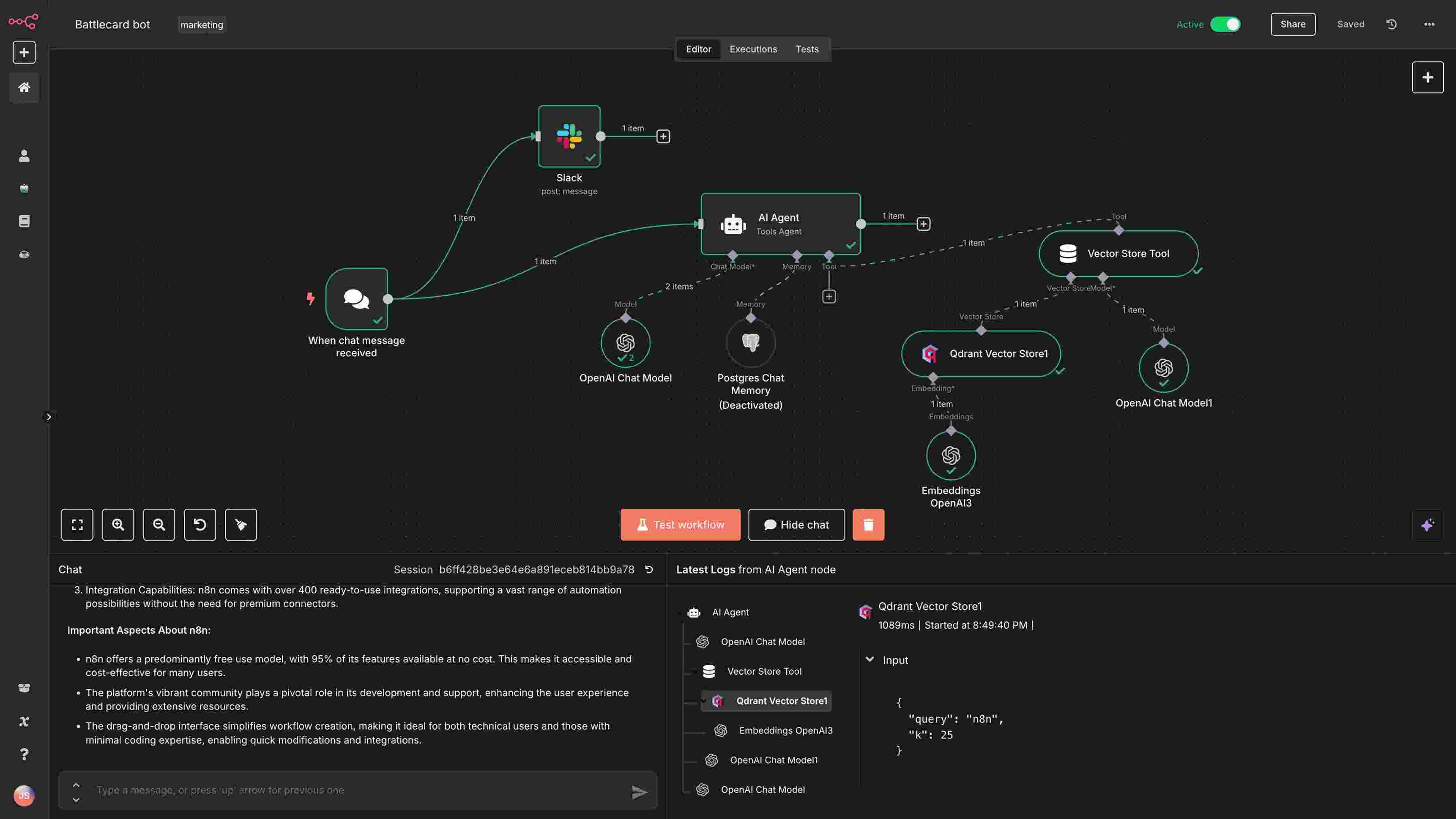
n8n logs every node's input and output for each execution, letting you inspect the exact data each step received. Source: n8n
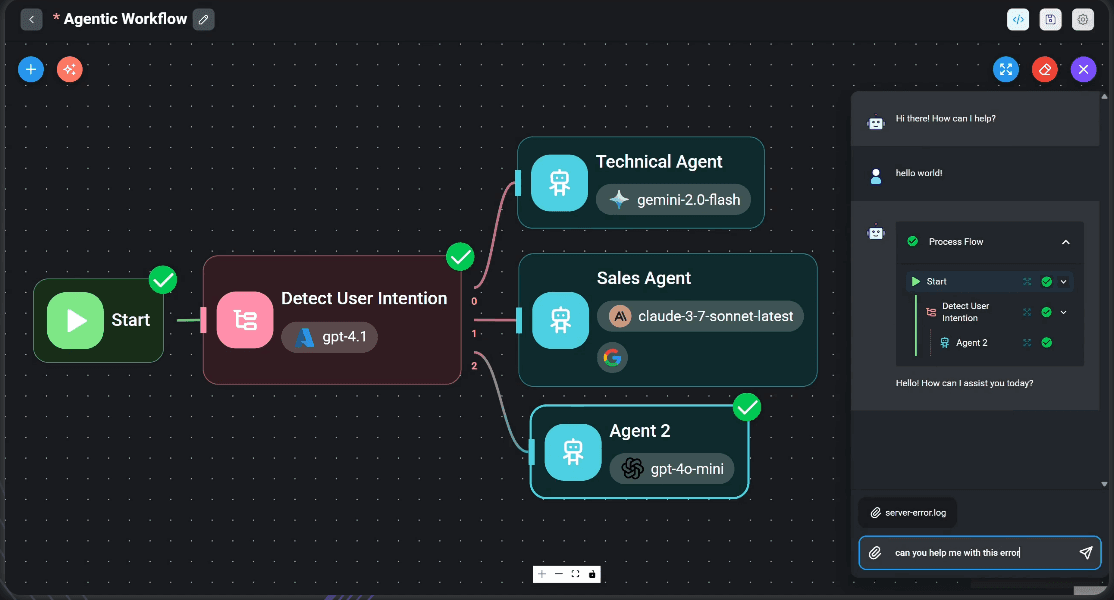
Flowise's process panel traces each step live during development, giving real-time visibility as a flow executes. Source: FlowiseAI
Selecting a platform depends on where you want the center of your technical complexity to live. Here are the factors that can make or break your Flowise-versus-n8n decision:
Flowise works great as a lab for AI experimentation. It’s where you go to perfect a prompt or test a new retrieval strategy for a chatbot with speed and specialized depth.
But when that AI needs to live in the real world — interacting with your CRM, managing your database, and following company security protocols — n8n is your best bet. It provides the infrastructure and deep visibility needed to ensure your AI agents aren’t just smart; they’re reliable, accountable members of your workforce. By treating AI as a core component of a broader automation engine, n8n makes sure your agents have the longevity required for a production-ready stack.
Ready to build? Use n8n to give your AI agents the orchestration they need to move beyond reasoning and start driving real operations. Get started for free or deploy a self-hosted Community Edition today.
Compare n8n vs. LangChain across execution, agent architecture, and deployment control. Weigh strengths and weaknesses, and discover which tool to use.
Find the best fit for your stack with this n8n vs Node-RED comparison. Review developer ergonomics, scaling, and AI nodes and integrations.
Compare n8n versus CrewAI to determine the best architecture for your team. Learn how both handle multi-agent systems, integrations, and observability.
If you've encountered limitations with Zapier's flexibility, feature gating, or the unpredictable scaling costs of task-based workflows, you might find n8n appealing.