See llms.txt for all machine-readable content.

SendGrid and Trengo integration

Save yourself the work of writing custom integrations for SendGrid and Trengo and use n8n instead. Build adaptable and scalable Marketing, Communication, workflows that work with your technology stack. All within a building experience you will love.

How to connect SendGrid and Trengo

Create a new workflow and add the first step

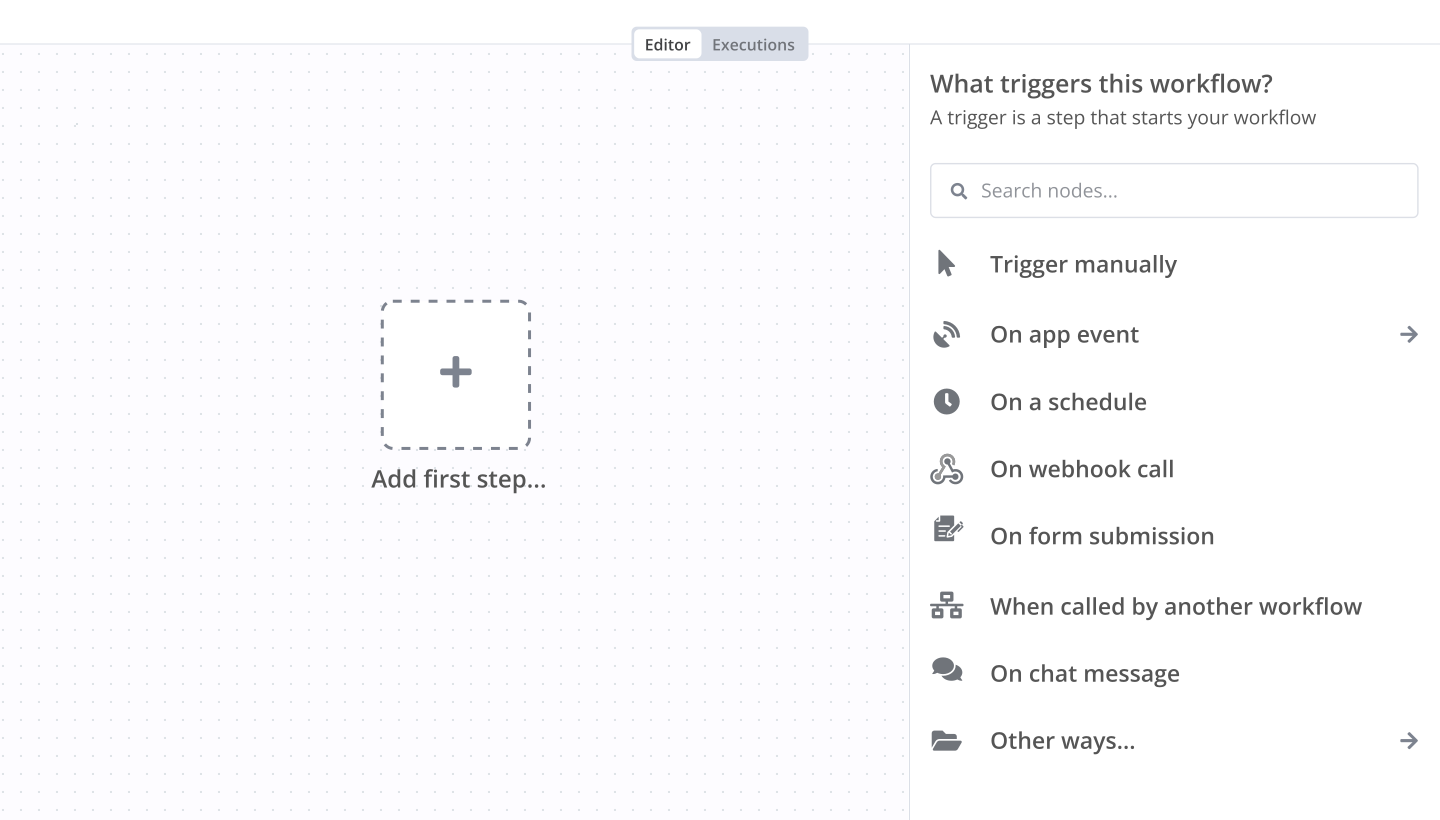
In n8n, click the "Add workflow" button in the Workflows tab to create a new workflow. Add the starting point – a trigger on when your workflow should run: an app event, a schedule, a webhook call, another workflow, an AI chat, or a manual trigger. Sometimes, the HTTP Request node might already serve as your starting point.

SendGrid and Trengo integration: Create a new workflow and add the first step

Track investments using Baserow and n8n

This workflow uses a number of technologies to track the value of ETFs, stocks and other exchange-traded products: Baserow: To keep track of our investments n8n’s Cron node: To trigger the workflow compiling our daily morning briefing Webscraping: The HTTP Request & HTML Extract nodes to fetch up-to-date prices from the relevant stock exchange and structure this infromation Javascript: We’ll use the Function node to build a custom HTML body with all the relevant information Sendgrid: The Email Service Provider in this workflow to send out our email Thanks to n8n, the steps in this workflow can easily be changed. Not a Sendgrid user? Simply remove the Sendgrid node and add a Gmail node instead. The stock exchange has a REST API? Just throw away the HTML Extract node. Here’s how it works: Data Source In this scenario, our data source is Baserow. In our table, we’ll track all information needed to identify each investment product: image.png We have two text type columns (Name and ISIN) as well as two number type columns (Count and Purchase Price). Workflow image.png Nodes 1. Cron The Cron node will trigger our workflow to run each work day in the morning hours. 2. Baserow The Baserow node will fetch our investments from the database table shown above. 3. HTTP Request Using the HTTP Request node we can fetch live data from the stock exchange of our choice based on the ISIN. This example uses Tradegate, which is used by many German fintechs. The basic approach should also work for other exchanges, as long as they provide the required data to the public. 4. HTML Extract Since our HTTP Request node fetches full websites, we’re using the HTML Extract node to extract the information we’re looking for from each website. If an exchange other than Tradegate is used, the selectors used in this node will most likely need to be updated. 5. + 6. Set The Set nodes helps with setting the exact columns we’ll use in our table. In this case we’re first formatting the results from our exchange, then calculate the changes based on the purchase price. 7. Function Here were using a bit of Javascript magic to build an HTML email. This is where any changes to the email content would have to be made. 8. Sendgrid Finally we send out the email built in the previous step. This is where you can configure sender and recipients. Result The basic email generated by this workflow will look like so: image.png

Popular ways to use the SendGrid and Trengo integration

Build your own SendGrid and Trengo integration

Create custom SendGrid and Trengo workflows by choosing triggers and actions. Nodes come with global operations and settings, as well as app-specific parameters that can be configured. You can also use the HTTP Request node to query data from any app or service with a REST API.

SendGrid supported actions

Supported API Endpoints for Trengo

To set up Trengo integration, add the HTTP Request node to your workflow canvas and authenticate it using a generic authentication method. The HTTP Request node makes custom API calls to Trengo to query the data you need using the API endpoint URLs you provide.

See the example here

These API endpoints were generated using n8n

n8n AI workflow transforms web scraping into an intelligent, AI-powered knowledge extraction system that uses vector embeddings to semantically analyze, chunk, store, and retrieve the most relevant API documentation from web pages. Remember to check the Trengo official documentation to get a full list of all API endpoints and verify the scraped ones!

SendGrid and Trengo integration details

SendGrid

SendGrid

SendGrid provides a cloud-based service that assists businesses with email delivery.

Trengo

Trengo

Trengo is a platform that combines multiple communication channels into one unified inbox. It helps businesses manage their customer interactions more efficiently, allowing them to provide quick and seamless support across channels like email, social media, chat, and phone calls.

Other integrations with SendGrid and Trengo

Automate lead management

Using too many marketing tools? n8n lets you orchestrate all your apps into one cohesive, automated workflow.

Learn more

FAQ about SendGrid integrations

Looking to integrate Slack and VirusTotal in your company?

Three colleagues talking around laptops at a shared desk

Trusted by teams building smarter workflows.

Why

Why use n8n to integrate SendGrid with Trengo

Handle branching, merging and iteration easily. Pause your workflow to wait for external events.

Re-run single steps to test changes in no time. And pin your data to avoid generating trigger events every time you execute.

Your data is displayed alongside your settings, making edge cases easy to track down.

Use 1000+ workflow templates available from our core team and our community.

Copy and paste, easily import and export workflows.
Simple enough to 
understand + sophisticated 
enough to ship

Man in a brown jacket working at his desk by a window