Use n8n when
You need event-driven or scheduled automation, real-time integrations, or AI agents with high visibility and low operational overhead.
Use CrewAI when
You manage complex, scheduled batch data pipelines at scale scripted with Python.
See llms.txt for all machine-readable content.
n8n and Airflow follow fundamentally different execution models: n8n handles event-driven and scheduled workflows through a visual interface; Airflow targets scheduled batch processing via Python-scripted DAGs. The right choice means evaluating scaling, security, and developer ergonomics in production, not just features.
This guide breaks down both to help you pick the right model for your stack.




You need event-driven or scheduled automation, real-time integrations, or AI agents with high visibility and low operational overhead.
You manage complex, scheduled batch data pipelines at scale scripted with Python.
While both tools primarily move data, they solve different engineering problems. Understanding the “why” behind their creation helps clarify which tool should anchor your automation stack.

n8n is a production-grade workflow automation tool built on a flexible architecture that supports both event-driven and scheduled workflows. Unlike traditional linear automation platforms, n8n is suitable for complex IT architectures.
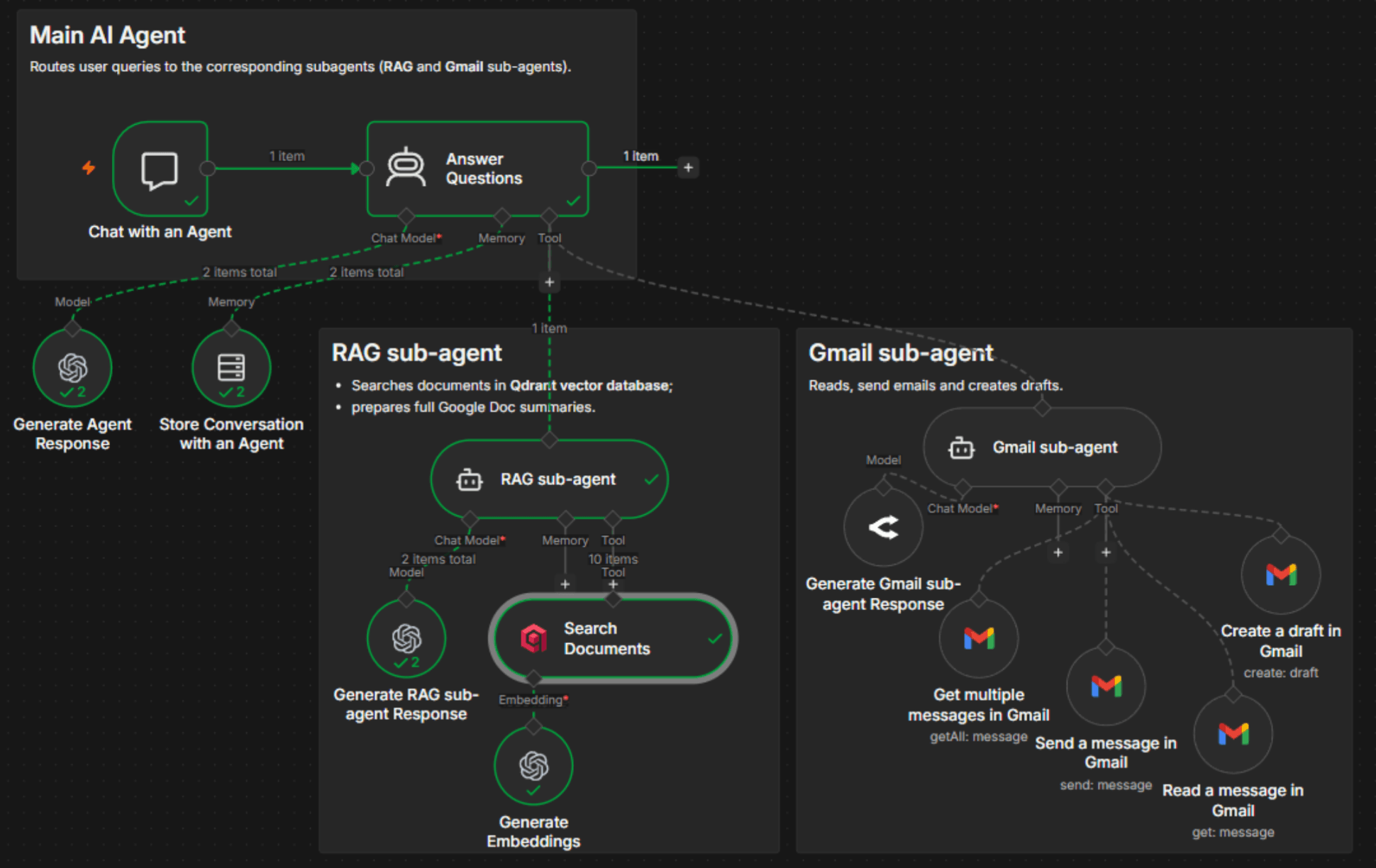
The platform is specifically designed to handle high-volume integrations and AI workflow deployments with ease. Its visual builder allows for rapid prototyping without sacrificing technical depth. For engineers, n8n acts as an Apache Airflow alternative when the goal is connecting disparate SaaS applications. It also supports building AI agents that require real-time triggers and human-in-the-loop interactions.
Apache Airflow is the industry standard for data orchestration, specifically designed to manage complex batch jobs and large-scale ETL pipelines. Its architectural foundation is the directed acyclic graph (DAG). This allows data engineering teams to define precise dependencies, retries, and monitoring gates in pure Python. Airflow excels in environments where reproducibility, version control, and strict code-first discipline are required to move terabytes of data across warehouses like Snowflake or BigQuery.
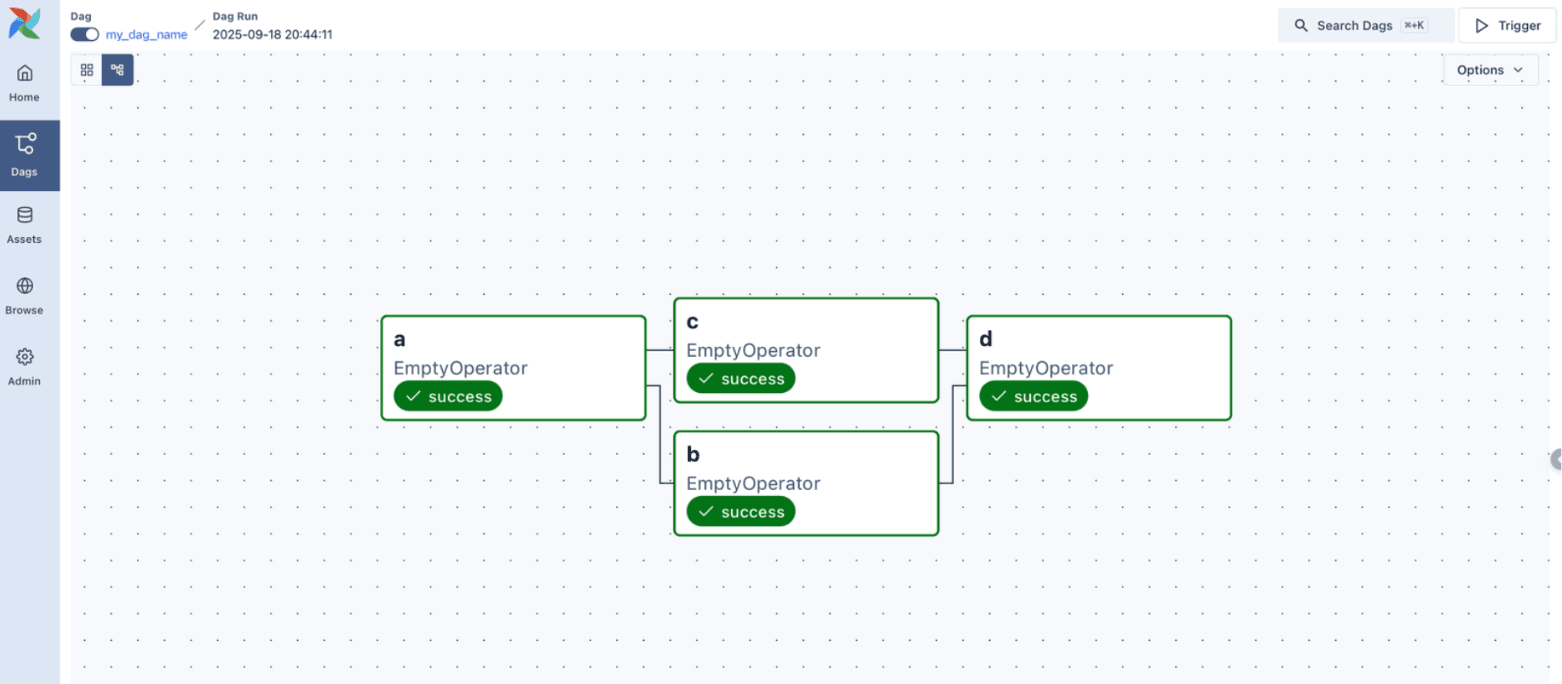
While Airflow offers deep visibility into long-running data tasks, the operational overhead of managing its multi-component stack is a trade-off for the precision it provides at scale.
Scaling a workflow engine in production requires a deep understanding of where the bottlenecks live. Some limits appear in CPU-bound task execution. Others emerge when the system coordinates thousands of concurrent triggers.
n8n scales for workflow concurrency instead of raw data throughput. When deployed in a queue mode, its architecture uses a workers model and Redis scheduler. This effectively decouples the main execution process from individual worker tasks, which allows n8n to remain highly responsive. For production environments, this setup is fully Kubernetes-compatible, enabling scaling driven by Horizontal Pod Autoscaler (HPA).
Many teams appreciate n8n’s operational simplicity compared to heavier stacks. n8n’s users often leverage n8n Cloud to offload infrastructure management entirely while maintaining the ability to scale
Airflow’s scalability is defined by its executor model. The LocalExecutor handles single-machine concurrency, while the CeleryExecutor distributes tasks across a pool of workers via a message broker. For those needing ephemeral isolation, the KubernetesExecutor spins up a dedicated pod for every task.
While this approach provides immense power, it comes with a steep learning curve. Teams have to manage the scheduler, heartbeat monitoring, and zombie task detection. These components form the coordination backbone and require dedicated DevOps capacity, especially as the number of DAGs grows.
As automation moves into the core of the enterprise, the ability to audit actions, restrict access, and manage credentials securely becomes non-negotiable for IT architects. Both tools offer governance features, but they take different approaches.
For enterprise-grade deployments, n8n provides strong governance through project isolation and role-based access control (RBAC). These features allow teams to silo workflows by department or environment. It supports SSO via SAML or OIDC, advanced secrets management, and detailed audit logs.
While n8n’s Community version is as powerful when it comes to building automations, the Enterprise tier is specifically designed to meet the compliance needs of large-scale IT organizations.
Airflow’s security model is built around its native RBAC, which controls access at the DAG and connection level. It offers five default roles (ranging from Admin to Public) and allows for custom role definition.
While Airflow supports LDAP and OAuth for authentication, there are often gaps in its native IAM capabilities compared to dedicated enterprise platforms. Security is largely managed at the "Connection" level, serving as a boundary for sensitive credentials used within Python DAGs.
The value of an orchestrator is often measured by its ecosystem. How easily it talks to your existing stack determines how much “glue code” your team will eventually have to maintain.
n8n ships with 1,000+ native integrations. These cover core business applications, AI services, and major cloud platforms. But its true strength is its near-limitless extensibility: If a pre-built node doesn’t exist, there are thousands of community nodes. Finally, the HTTP Request node can interface with any REST or GraphQL API in minutes.
None of these capabilities require Python packaging or provider development. That’s why teams building customer-facing workflows, AI agents, or cross-app automation often choose n8n’s visual integration model over code-first alternatives. And since n8n is source-available, technical teams can inspect the code or modify the platform to suit highly specific internal requirements.
Airflow’s extensibility is handled through providers — installable Python packages that contain hooks and operators for specific services. This approach is ideal for data-centric tools like Snowflake, Spark, or dbt.
Adding a new integration in Airflow typically requires writing Python code and managing dependencies. While that’s more time-consuming than n8n’s visual approach, it offers more granular control over how data is moved at the protocol level.
The rise of large language models (LLMs) has changed what teams need from orchestration tools. Workflows now shift from static data movement to dynamic, agentic reasoning loops that require real-time feedback.
n8n treats AI as a core execution primitive. The platform is engineered for real-time AI inference, supporting conversational agents and complex LLM orchestration through native AI Agent nodes. These nodes support tool calling, long-term memory, and retrieval-augmented generation (RAG). This lets engineers build agentic structures that act as autonomous systems.
By routing logic based on LLM reasoning and including human-in-the-loop checkpoints, n8n bridges the gap between static automation and dynamic, inference-time decision-making. Organizations with strict data residency requirements can deploy this logic as a self-hosted AI solution to maintain total privacy over sensitive payloads.
Airflow’s strength lies in the MLOps pipelines that power the models themselves. It excels at batch ML training and scheduled inference. These pipelines move large volumes of training data, trigger evaluation gates, and manage model deployment promotions. Unlike n8n’s native agent primitives, Airflow mostly supports LLM-based automations within a larger pipeline. But it’s not designed for the low-latency requirements of real-time, conversational AI orchestration.
From trigger to production in minutes
Total cost of ownership involves more than just a monthly subscription. To get the full picture, you need to factor in the hidden costs of server maintenance, specialized hiring, and infrastructure management.
n8n operates under a fair-code license. The self-hosted Community tier is free to use with no execution limits, making it a highly accessible choice for independent developers. Paid cloud plans are execution-based. Enterprise licensing unlocks advanced governance features (SSO, RBAC) and dedicated support SLAs for mission-critical workloads.
As a 100% open-source project under the Apache 2.0 license, Airflow has no licensing fees. But the true cost lies in the infrastructure and the engineering hours required to maintain the complex multi-component stack. When you look at the big picture, the operational overhead of managing a production-ready Airflow cluster will likely far exceed the cost of a managed SaaS license.
A tool's developer ergonomics determine how quickly a team can move from an idea to a deployed workflow. They also influence how easily that logic can be maintained over time.
n8n’s developer ergonomics are built around flexibility. It supports:
The Code node supports both JavaScript and Python. This enables arbitrary logic execution within a workflow without leaving the orchestration layer.
Some teams need to enforce environmental separation . n8n offers Git-based workflow version control (Enterprise) and flexible environment promotion pipelines (dev → staging → prod). This closes the gap with traditional software delivery practices.
Engineers can also commit, review, and deploy workflows through standard Git operations. This gives teams the speed of visual construction and the safety of a mature CI/CD pipeline.
Airflow’s DAG-as-code model is its primary selling point for engineering teams. Every pipeline is a first-class software citizen. This allows for unit testing, CI/CD, and complex logic branches that follow the same PR-and-review process as any other internal service. It’s a strong fit for Python developers who want total control over their orchestration logic.
The trade-off is a lack of usability for anyone outside the engineering department. Without deep Python knowledge, non-engineers can’t participate in building, modifying, or even troubleshooting workflows. While this enforces a high level of discipline, it also creates a bottleneck where simple business logic changes require a full developer deployment cycle.
When a production workflow fails, the speed of a diagnosis determines whether the incident is a minor blip or a major outage.
n8n focuses on high visibility for debugging. Each execution visualizes data flow through every node. This lets engineers spot errors instantly. It also integrates with external log aggregators and exposes metrics endpoints for Prometheus-based monitoring stacks.
Airflow provides sophisticated failure handling, including complex retry logic and SLA monitoring. But debugging often requires digging through raw Python logs across various workers and the metadata DB. While powerful for seeing where a massive data pipeline failed, Airflow is generally less ergonomic for inspecting individual integration payloads.
To determine the right fit for your production environment, look at four critical signals: latency requirements, data volume, team skillset, and operational capacity.
In many mature production environments, the most effective strategy is a hybrid architecture. Since many systems require both real-time responsiveness and heavy-duty processing, teams often use n8n and Airflow as complementary layers.
For example, n8n handles the scheduled or event-driven front end of the workflow. It detects a customer-onboarding trigger, updates the CRM, and sends Slack notifications in real time.
Once the business logic is satisfied, n8n makes an API call to Airflow to trigger the heavy lifting. Airflow then backfills historical data, creates warehouse tables, or runs multi-hour ML scoring jobs. This allows each tool to operate within its primary design constraint: n8n for integration agility and Airflow for batch data reliability.
Savvy teams don’t outgrow the right tool — they complement it with new tools as their needs evolve. If you're building real-time business logic today, start with n8n. If you find yourself drowning in massive data dependencies tomorrow, add Airflow. Choose based on what you’re orchestrating today, not what a tool can theoretically do in a year.
Ready to build your first scalable workflow? Sign up and see how n8n handles real-time orchestration.
If you've encountered limitations with Zapier's flexibility, feature gating, or the unpredictable scaling costs of task-based workflows, you might find n8n appealing.
If you’ve run into limits with Make’s operation-based pricing, data caps, or cloud-only setup, n8n might be a more flexible and cost-efficient alternative.
Find the best fit for your stack with this n8n vs Node-RED comparison. Review developer ergonomics, scaling, and AI nodes and integrations.
Compare n8n versus CrewAI to determine the best architecture for your team. Learn how both handle multi-agent systems, integrations, and observability.