See llms.txt for all machine-readable content.



Your automated multilingual support assistant that translates, generates AI responses, and translates back to the customer's language with comprehensive error handling.
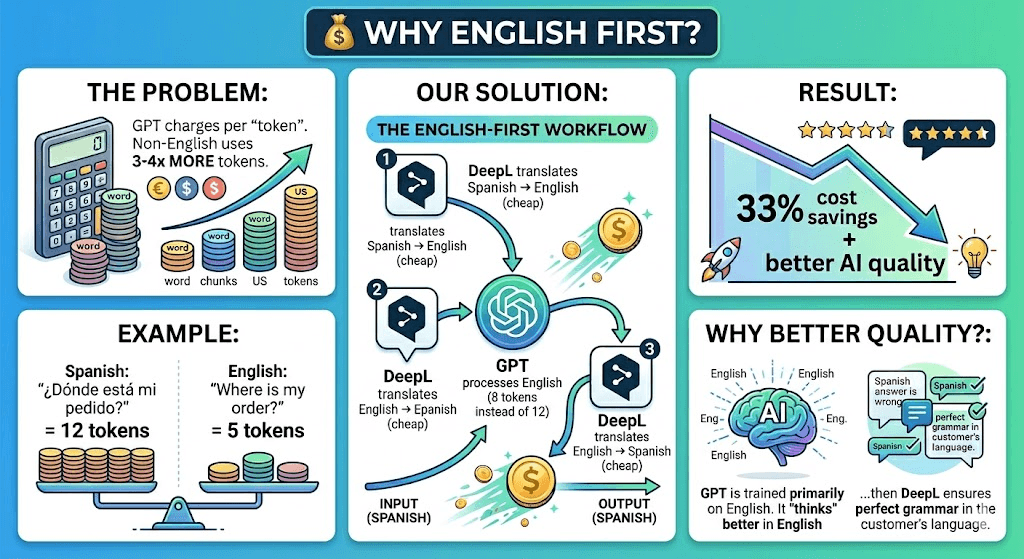
Stop manually copy-pasting customer messages into Google Translate and crafting responses in multiple languages. This workflow orchestrates the entire multilingual support pipeline: captures requests via form, auto-detects and translates to English, generates professional AI responses, and translates back to the customer's native language automatically. You handle the business; it handles the languages.
This is not a generic "translation" template. It is a functional bidirectional communication pipeline designed to maintain conversation quality across 29 languages with production-grade error recovery.
How the workflow works
The workflow executes in five strategic stages:
-
Form Capture & Validation: Customer submits request via n8n form (email, question, language dropdown with 29 options). Validates email format, message length (5+ chars), and extracts ISO language code.
-
Native DeepL Translation (Customer → English): Auto-detects source language and translates customer message to English using n8n's native DeepL node for clean AI input.
-
AI Response Generation: GPT-3.5-turbo generates professional, empathetic support response in English (2-3 paragraphs, actionable next steps, no unverified promises).
-
Native DeepL Back-Translation (English → Customer): Translates AI response back to customer's original language, preserving technical accuracy with natural phrasing.
-
Gmail Delivery & Error Handling:
- Success: Beautiful HTML email sent to customer with translated response, English version (collapsible), and metadata
- Failures: Professional error emails sent for validation (HTTP 400), translation failures (HTTP 502 + retry 60s), AI failures (HTTP 502 + retry 30s), or back-translation failures (English version sent as fallback)
Benefits
-
Bidirectional Translation Flow: Unlike generic translation templates that only translate TO English, this workflow translates both directions (Customer → English → Customer), ensuring responses are delivered in the customer's native language.
-
Native DeepL Integration: Uses n8n's built-in DeepL node instead of complex HTTP API configurations. Setup time: 3 minutes vs 15 minutes for HTTP-based approaches.
-
Production-Grade Error Handling: Four error checkpoints with specific HTTP status codes (400 for validation, 502 for API failures) and actionable error messages. Includes English fallback when back-translation fails so you never lose a generated response.
-
Form-Based Input (No Webhook Config): Beautiful embedded n8n form with language dropdown eliminates the need for complex webhook integrations or API documentation for end users.
-
Beautiful HTML Email Delivery: Modern, mobile-responsive email templates with gradient headers, collapsible sections, and clear CTAs. Five different templates for success and error states.
-
Cost Efficiency: ~$0.001 per request (DeepL + OpenAI combined) vs $50-150/month per multilingual support agent. ROI: 25x in Year 1 for teams handling 100+ multilingual requests/month.
Target Audience
-
E-commerce Businesses serving international customers across the EU, LATAM, or APAC regions needing support in local languages.
-
SaaS Companies with global user bases where language barriers create support bottlenecks and increase ticket resolution time.
-
Customer Success Teams at startups expanding internationally without budget for multilingual support staff.
-
Agencies & MSPs managing client support across multiple languages and needing to scale without hiring language specialists.
Required APIs
- DeepL API for bidirectional translation (free tier: 500k chars/month covers ~3,300 requests)
- OpenAI API for GPT-3.5-turbo response generation (~$0.001 per response)
- Gmail OAuth2 for sending beautiful HTML email responses to customers
- n8n Form Trigger requires public n8n instance (Cloud or self-hosted) to generate embeddable form URL
Easy Customization
-
Adjust Language Support: Edit the language dropdown in the Form Trigger node to add/remove languages based on your customer base (currently 29 languages supported).
-
Notification Channels: Add Slack, Discord, or Microsoft Teams nodes after Gmail nodes to notify your support team when responses are sent or errors occur.
-
Custom Email Templates: Modify the HTML in Gmail nodes to match your brand colors, fonts, and messaging style.
-
AI Model Upgrade: Swap GPT-3.5-turbo for GPT-4o in the OpenAI node for 2x better response quality at ~$0.02/request (ideal for high-value customers or complex support queries).
-
Output Logging: Add Google Sheets, Airtable, or PostgreSQL nodes after Gmail nodes to log all translations for quality auditing, CSAT tracking, or training data collection.
-
Custom Prompt Engineering: Modify the OpenAI system prompt to include company-specific tone, product knowledge, or escalation criteria (e.g., detect refund requests and flag for human review).