See llms.txt for all machine-readable content.
Back to integrations
HTTP Request and Pusher integration
Save yourself the work of writing custom integrations for HTTP Request and Pusher and use n8n instead. Build adaptable and scalable Development, Core Nodes, workflows that work with your technology stack. All within a building experience you will love.




How to connect HTTP Request and Pusher
Create a new workflow and add the first step
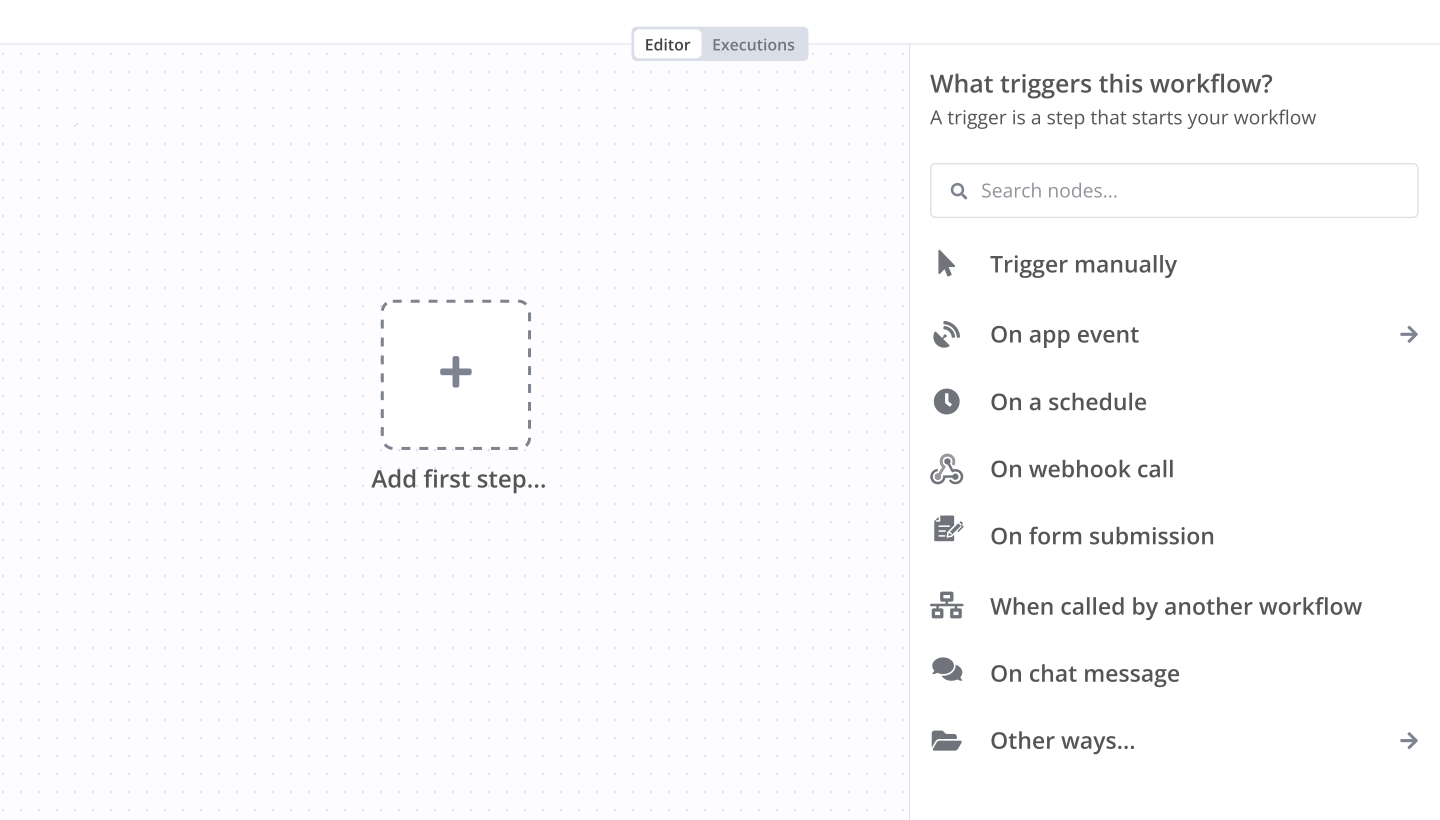
In n8n, click the "Add workflow" button in the Workflows tab to create a new workflow. Add the starting point – a trigger on when your workflow should run: an app event, a schedule, a webhook call, another workflow, an AI chat, or a manual trigger. Sometimes, the HTTP Request node might already serve as your starting point.
Build your own HTTP Request and Pusher integration
Create custom HTTP Request and Pusher workflows by choosing triggers and actions. Nodes come with global operations and settings, as well as app-specific parameters that can be configured. You can also use the HTTP Request node to query data from any app or service with a REST API.
Supported API Endpoints for Pusher
POST
Trigger event
Trigger an event on a specified channel.
/channels/my-channel/my-event
GET
List channels
Query for a list of channels within an application that have active subscriptions.
/channels
GET
Get channel information
Retrieve the state of an individual channel by its name.
/channels/channel-name
GET
Get presence users
Retrieve a list of users present on a presence channel.
/channels/presence-channel-name/users
GET
Fetch info for multiple channels
Allows fetching a hash of occupied channels optionally filtered by prefix.
/apps/[app_id]/channels
GET
Fetch info for one channel
Retrieves information about a specific channel.
/channels/{channel_name}
POST
Trigger event
Triggers an event on one or more channels.
/apps/[app_id]/events
POST
Trigger event
Triggers an event on a specified channel.
/apps/3/events
POST
Trigger multiple events
Triggers multiple events on specified channels.
/apps/3/events/batch
POST
Trigger multiple events
Triggers multiple events in a single call (up to 10 per call on the multi-tenant clusters).
/apps/[app_id]/batch_events
GET
Fetch info for one channel
Fetch one or some attributes for a given channel.
/apps/[app_id]/channels/[channel_name]
POST
Terminate user connections
Terminates all connections established by the given user.
/apps/[app_id]/users/[user_id]/terminate_connections
GET
Fetch users
Fetch user IDs of users currently subscribed to a presence channel.
/apps/[app_id]/channels/[channel_name]/users
POST
Terminate user connections
Terminates all connections of a specified user.
/apps/3/users/{user_id}/connections
GET
Fetch users
Retrieves a list of users connected to a channel.
/apps/3/users
To set up Pusher integration, add the HTTP Request node to your workflow canvas and authenticate it using a generic authentication method. The HTTP Request node makes custom API calls to Pusher to query the data you need using the API endpoint URLs you provide.
See the example hereThese API endpoints were generated using n8n
n8n AI workflow transforms web scraping into an intelligent, AI-powered knowledge extraction system that uses vector embeddings to semantically analyze, chunk, store, and retrieve the most relevant API documentation from web pages. Remember to check the Pusher official documentation to get a full list of all API endpoints and verify the scraped ones!
HTTP Request and Pusher integration details
HTTP Request
Related categories
FAQs
FAQ
Need help setting up your HTTP Request and Pusher integration?
Discover our latest community's recommendations and join the discussions about HTTP Request and Pusher integration.

Self-host [email protected] login page error
Mohiria
Self-Hosted n8n (v1.120.4) Fails to Load in Browser with Cannot read properties of undefined (reading 'ldap') TypeError description: Issue: I self-hosted n8n version 1.120.4 using Docker. The container logs confirm the s…

JSON parameter needs to be valid JSON on an HTTP request
Armand Ferveur
Hey, I tried to call the Gemini 2.5 flash image model via HTTP request, but I’m getting this error that I can’t seem to resolve in the JSON code. I feel like I’m doing it right, and ChatGPT doesn’t see any errors either.…

Getting detailed error messages when AI Agent tools fail
Agustin Pezzani
Hello n8n Community, I’m facing an issue when using Tools within the AI Agent node, specifically when one of the tools fails for a valid reason (e.g., an external API returns an expected error). The Problem: When a T…

I have an issue when sending an http request to fal.ai to get results api
Ahmed Ennaime
Description: I’m trying to send a GET http request to fal.ai to get results but it fails everytime even though the credentials are right in the headers, this api doesn’t take anything in the body (API link: Ffmpeg Api Me…

Google Verification Denied
Moiz Contractor
Describe the problem/error/question Hi, I am getting a - Google hasnt verified this app error. I have Enable the API, the domain is verified on the Cloud Console, the user is added in the search console and the google do…
AI agents and workflows for technical teams at


Why use n8n to integrate HTTP Request with Pusher
Build complex workflows, really fast